Blaise Pascal
French mathematician, physicist, inventor, writer, and Christian philosopher (1623-1662) · France · Academics · Died at 39
Blaise Pascal is read about 2,979 times a day, in 136 languages.
A typical day, 30 days to 15 October 2026
The middle day of the days counted, so one week of news cannot move it. The line under it is the last 390 days, one point a day.
Something wrong?A 17th-century polymath who invented an early mechanical calculator at 21, laid groundwork for probability theory, proved that vacuums exist against centuries of dogma, and closed his life writing a famous wager about God framed as a bet worth taking.
Also in Deutsch
Photos 8
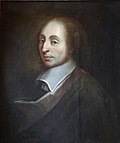
 Blaise Pascal Versailles
 (S. Clerestory 1) Science Window
 Acte de baptême de Blaise Pascal 1623 AD63
 Anonymous - Portrait présumé de Blaise Pascal (1623-1662), savant et écrivain. - P1800 - Musée Carnavalet
 Armoiries Pascal - Bouillet Nobiliaire
 Blaise Pascal works p14
 Blaise Pascal. Line engraving by Walker, Wellcome V0004508
 BOYER 2159 - Pavillon où est mort Pascal, rue Neuve-Saint-Etienne, à Paris
In their own words 10
 ,
People almost invariably arrive at their beliefs not on the basis of proof but on the basis of what they find attractive.
Mahomet established a religion by putting his enemies to death; Jesus Christ, by commanding his followers to lay down their own lives.
Do not imagine that it is less an accident by which you find yourself master of the wealth which you possess, than that by which this man found himself king.
Family
Parents
 Blaise Pascal
Brothers and sisters


Is this everyone?
Only relatives with a profile here are drawn, so a family can be larger than this. A line here can also be wrong.
Correct this familyAbout this person
Blaise Pascal was educated at home by his father, a tax collector in Rouen, and published a treatise on conic sections at 16. In 1642 he began work on calculating machines now called Pascalines, making him one of the first inventors of the mechanical calculator. He corresponded with Pierre de Fermat on probability theory, shaping modern economics and social science, and in 1647 rebutted Aristotle and Descartes by demonstrating that nature does not abhor a vacuum, clarifying concepts of pressure that now carry his name in the SI unit. In 1646 he and his sister Jacqueline turned toward Jansenism; after a religious experience in 1654 he wrote the Lettres provinciales and the Pensées, the latter containing Pascal's wager - a probabilistic argument for belief in God. He also wrote on the arithmetical triangle that year and on the cycloid between 1658 and 1659. Shortly before his death in Paris at 39, he established the carrosses à cinq sols, the first modern public transport service.




Fame.am measures public visibility signals. It does not measure human value, talent, morality, or credibility.