Abdullah I of Jordan
Ruler of Transjordan and Jordan from 1921 to 1951 · Turkey · Historical Figures · Lived 1882 to 1951 · aged 69
Abdullah I of Jordan is read about 1,068 times a day, in 67 languages.
A typical day, 30 days to 15 October 2026
The middle day of the days counted, so one week of news cannot move it. The line under it is the last 390 days, one point a day.
Something wrong?A Hashemite prince who rode the Arab Revolt into power, then spent three decades threading the needle between British alliance and Arab nationalism - until a bullet outside Al-Aqsa ended the balancing act.
Also in Deutsch
Photos 8
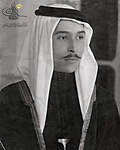
 Portrait of Abdullah bin Hussein
 (R-L) THOMAS EDWARD LAWRENCE, JORDANIAN RULER EMIR ABDULLAH & BRITISH GEN. EDMUND ALLENBY WHO CONQUERED PALESTINE FROM THE OTTOMANS POSE TOGETHER IN J
 (R-L) THOMAS EDWARD LAWRENCE, JORDANIAN RULER EMIR ABDULLAH & BRITISH GEN. EDMUND ALLENBY WHO CONQUERED PALESTINE FROM THE OTTOMANS POSE TOGETHER IN JD741-013
 (R-L) THOMAS EDWARD LAWRENCE, JORDANIAN RULER EMIR ABDULLAH & BRITISH GEN. EDMUND ALLENBY WHO CONQUERED PALESTINE FROM THE OTTOMANS POSE TOGETHER IN JD741-014
 Kingabdullahkingtalalsheikhmithqal
 Kingabdullahkingtalalsheikhmithqalcropped
 Emir Abdullah I with his son Talal and Naif, 1930s
 Emir Saud's visit to Emir Abdullah in Amman. Emir Saud & Talal (Emir Abdullah's son) at a military display in his honour, closer view LOC matpc.18942
Awards
Family
Parents

 Abdullah I of Jordan
Partners
Children

Brothers and sisters


Is this everyone?
Only relatives with a profile here are drawn, so a family can be larger than this. A line here can also be wrong.
Correct this familyAbout this person
Born in Mecca in 1882, Abdullah bin Hussein was the second son of the Sharif and sat in the Ottoman legislature before the world broke open. During the First World War he brokered secret talks with Britain and led guerrilla raids that fed the Arab Revolt his father commanded. In April 1921 he became Emir of Transjordan, a British protectorate carved from imperial rubble. He kept faith with London through the Second World War and claimed his crown when independence arrived in 1946. Four years later he annexed the West Bank, a move that set Syria, Saudi Arabia, and Egypt against him. On 20 July 1951, a Palestinian gunman shot him at the entrance to Al-Aqsa Mosque during Friday prayers. His eldest son Talal inherited the throne.
Historical Figures from Turkey 6


Fame.am measures public visibility signals. It does not measure human value, talent, morality, or credibility.