Robert Burns
Scottish poet and lyricist (1759-1796) · United Kingdom · On the map · Writers · Died at 37
He wrote in a language most of the world didn't speak, died at 37, and became Scotland's secular saint - the poet whose work gets sung drunk at midnight on New Year's Eve and whose birthday is a global excuse to eat haggis and raise a glass.
Robert Burns is read about 1,024 times a day, in 89 languages.
A typical day, 30 days to 10 November 2026
The middle day of the days counted, so one week of news cannot move it. The line under it is the last 402 days, one point a day.
Something wrong?People around Robert


Parents


 Robert Burns
Partners

Is this everyone?
Only relatives with a profile here are drawn, so a family can be larger than this. A line here can also be wrong. A marriage is drawn as ended only where its end is recorded, so a spouse drawn here may be a former one.
Correct this familyAlso in Deutsch
Media & music
Photos 11

 Burns Cottage in Alloway, South Ayrshire
 A depiction of the Burns family inside the Burns Cottage
 Burns House and Museum in Mauchline, East Ayrshire
 This manuscript copy of 'Address to Edinburgh' written in Burns's hand, was sent in 1787 to Lady Henrietta Don (nee Cunningham), sister to Earl of Glencairn. The manuscript is now part of the Laing Collection at the University of Edinburgh.
 Burns statue by David Watson Stevenson (1898) in Bernard Street, Leith
 Ellisland Farm in the time of Robert Burns
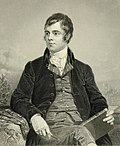
 Alexander Nasmyth, Robert Burns (1828)
About this person
Robert Burns was born in January 1759 in Scotland and spent his short life writing in Scots, light Scots dialect, and standard English - the last being where his sharpest political edges showed. He composed original work and collected folk songs across Scotland, revising them as he went, and in the 1780s and 1790s produced the pieces that would outlive him: "To a Mouse" in 1785, "Auld Lang Syne" in 1788, "Tam o' Shanter" in 1790, "A Red, Red Rose" in 1794. He died in July 1796, but what followed was stranger than fame - he became a founding ghost for liberalism and socialism, a cultural icon in the Scottish diaspora, and the center of something close to a national cult through the 19th and 20th centuries. In 2009, more than two centuries after his death, a public vote named him the greatest Scot.