Arthur C. Clarke
British science fiction writer, inventor, and futurist (1917-2008) · United Kingdom · Writers · Died at 90
Arthur C. Clarke is read about 3,345 times a day, in 90 languages.
A typical day, 30 days to 15 October 2026
The middle day of the days counted, so one week of news cannot move it. The line under it is the last 390 days, one point a day.
Something wrong?He sketched the satellite grid that would wire the planet decades before the first one launched, then co-wrote the film that redefined what science fiction could be on screen.
A life in dates
Also in Deutsch
Photos 8

.jpg?width=1200)

.jpg?width=1200)
.jpg?width=1200)

_-_I_Romanzi_di_Urania_Mondadori_10_ottobre_1952.jpg?width=1200)

In their own words 10
 ,
, If the artist did not know his goal, even the most miraculous of tools could not find it for him.
Somewhere back at the beginning I was chosen to be Jester, and there is only one Jester at a time in Diaspar. Most people think that is one too many.
There still remained, for all men to share, the linked worlds of love and art.
Awards
In their orbit
About this person
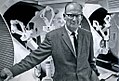
Clarke joined the British Interplanetary Society as a teenager in 1934 and in 1945 proposed a satellite communication system using geostationary orbits - a concept that would underpin global telecommunications. His science fiction writing, which earned him Hugo and Nebula awards and a UNESCO Kalinga Prize in 1961, placed him alongside Robert Heinlein and Isaac Asimov in the genre's "Big Three." The 1968 screenplay he co-wrote for 2001: A Space Odyssey became one of the most influential films ever made. In 1956 he moved to Ceylon to dive, discovered underwater ruins of the ancient Koneswaram Temple in Trincomalee, and stayed. He hosted Arthur C. Clarke's Mysterious World in the 1980s, was knighted in 1998, and received Sri Lanka's highest civil honour in 2005, seven years before his death.




Fame.am measures public visibility signals. It does not measure human value, talent, morality, or credibility.