207,380 profiles ranked

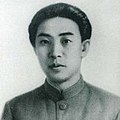
Kim Il-sung

Supreme Leader of North Korea from 1948 to 1994 · North Korea · Politicians · Lived 1912 to 1994 · aged 82 · also Russia

Kim Il-sung is read about 5,493 times a day, in 140 languages.

A typical day, 30 days to 15 October 2026

The middle day of the days counted, so one week of news cannot move it. The line under it is the last 390 days, one point a day.

Something wrong?
Compare

He founded North Korea in 1948, launched the Korean War in 1950, and ruled for more than 45 years as the architect of a totalitarian state built on the Juche ideology of self-reliance and an all-consuming personality cult that outlasted Stalin and Mao.

A life in dates

1994Died8 July 1994“We've always been under sanctions.”In their wordsJune 1994Remarks to Jimmy Carter (June 1994), as recalled during his final policy meeting and featured in the KCTV documentary The Year 1994 of the

1993“Engels once called the British army the most brutal army. During the Second World War, the German fascist army surpassed the barbarism of the British army.”In their wordsKim Il-sung to the Swedish communist leader Frank Baude in 1993. Quote and translated fr Mot strömmen, pg. 186: "Engels kallade en gång den

1991“The national assembly of each country, as its highest legislative body, has a mission and responsibility to realise democratic government.”In their words29 April 1991For a free and peaceful new world, Speech at the opening ceremony of the 85th Inter-parliamentary Conference (April 29, 1991)

1987Order of Klement GottwaldAwardOrder of Playa GirónAwardOrder of the Victory of SocialismAward1986Order of José MartíAward1984Order of Eduardo Mondlane, 1st classAward1982Hero of the RepublicAward1976“The people are the masters of the revolution in each country. It is like putting a cart before the horse that foreigners carry out the revolution for them.”In their wordsQuoted in Kim Il Sung, Master of Leadership (1976) by Takagi Takeo

1973Order of the White LionAward1972Hero of the RepublicAwardPresident of North KoreaOffice1972-19941971Star of the Socialist Republic of RomaniaAward1970Jubilee Medal "In Commemoration of the 100th Anniversary of the Birth of Vladimir Ilyich Lenin"Award1958Hero of LaborAward1955“What is Juche [the subject] in our Party's ideological work? What are we doing? We are not engaged in any other country's revolution, but precisely in the Korean revolution.”In their words28 December 1955"On eliminating dogmatism and formalism and establishing Juche in ideological work" (28 December 1955), in Works vol. 9

1953Hero of the RepublicAwardOrder of Freedom and Independence, 1st classAward1950Supreme Commander of the Korean People’s ArmyOffice1950-19911949General Secretary of the Workers' Party of KoreaOffice1949-19941948Premier of North KoreaOffice1948-1972Supreme Leader of North KoreaOffice1948-19941945“The time has come when we Korean people have to unite our strength to build a new, democratic Korea.”In their words14 October 1945Victory speech in Pyongyang (14 October 1945), in Works vol. 1

Order of the Red BannerAward1912Born15 April 1912

Also in Deutsch

Photos 8

In their own words 10

,
Kim Il-sung
,
10 statements, newest first
  1. We've always been under sanctions.

    Jun 1994, Remarks to Jimmy Carter (June 1994), as recalled during his final policy meeting and featured in the KCTV documentary The Year 1994 of the, Own words

  2. Engels once called the British army the most brutal army. During the Second World War, the German fascist army surpassed the barbarism of the British army.

    1993, Kim Il-sung to the Swedish communist leader Frank Baude in 1993. Quote and translated fr Mot strömmen, pg. 186: "Engels kallade en gång den, Own words

  3. The national assembly of each country, as its highest legislative body, has a mission and responsibility to realise democratic government.

    Apr 29, 1991, For a free and peaceful new world, Speech at the opening ceremony of the 85th Inter-parliamentary Conference (April 29, 1991), Own words

Wikiquote, CC BY-SA 4.0

Awards

Order of Klement Gottwald1987
Order of the Victory of Socialism1987
Order of Playa Girón1987
Order of José Martí1986
Order of Eduardo Mondlane, 1st class1984
Hero of the Republic1982
Order of the White Lion1973
Hero of the Republic1972
Order of Lenin1972
Star of the Socialist Republic of Romania1971
Jubilee Medal "In Commemoration of the 100th Anniversary of the Birth of Vladimir Ilyich Lenin"1970
Hero of Labor1958
Hero of the Republic1953
Order of Freedom and Independence, 1st class1953
Order of the Red Banner1945
Order of Karl Marx
Order of Augusto César Sandino
Order of the National Flag
Order of Sukhbaatar
Order of the Tribute to the Republic
Order of the Yugoslavian Great Star
Grand Cross of the National Order of Mali
Star of the Republic of Indonesia
Grand Cross of the Royal Order of Cambodia
National Order of Madagascar
Order of the Yugoslav Star
Order of Mono
Grand Cross of the Order of Polonia Restituta

Family

Is this everyone?

Only relatives with a profile here are drawn, so a family can be larger than this. A line here can also be wrong.

Correct this family

About this person

Kim Song Ju was born in Japanese-ruled Korea on 15 April 1912 and grew up in northeast China, where he joined anti-Japanese guerrilla groups as a teenager and the Chinese Communist Party in 1931. He fought with CCP-led units until 1942, when he was assigned to the Soviet Red Army and remained in the Soviet Union until 1945. After Japan's surrender and Korea's division, the Soviets installed him in the North, and in 1948 he established the Democratic People's Republic of Korea. He authorized the invasion of South Korea in 1950, triggering a United Nations intervention led by the United States; the war ended in stalemate with a ceasefire signed in July 1953. Under his rule, North Korea became a centrally planned socialist dictatorship with close Soviet and Chinese ties, and by the 1960s had a slightly higher standard of living than the chaotic South - a gap that reversed in the 1970s as South Korea's economy surged and the North stagnated. Kim developed Juche, an ideology of independence and Korean nationalism that set him apart from Moscow, though the country still relied on Soviet subsidies until 1991, when their loss contributed to the famine of 1994. He died on

Country
North Korea
Category
Politicians
Type
Politician
Status
deceased
Dates
Lived 1912 to 1994 · aged 82

Fame.am measures public visibility signals. It does not measure human value, talent, morality, or credibility.