José Ortega y Gasset
Spanish liberal philosopher and essayist (1883-1955) · Spain · Academics · Died at 72
José Ortega y Gasset is read about 849 times a day, in 57 languages.
A typical day, 30 days to 15 October 2026
The middle day of the days counted, so one week of news cannot move it. The line under it is the last 390 days, one point a day.
Something wrong?The Spanish philosopher who built a "philosophy of life" while his country lurched from monarchy to republic to dictatorship - blending American pragmatism, German phenomenology, and a proto-existentialism that predated Heidegger.
A life in dates
Also in Deutsch
Photos 8
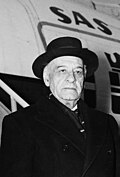
 José Ortega y Gasset (cropped)
 1927-03-19, La Esfera, En el Salón Nancy. Una exposición de dibujos
 1928-02-15, La Gaceta Literaria, José Ortega y Gasset
 1928-08-05, El Sol, Ortega y Gasset sale para la Argentina, Bagaría
 Biblioteca Básica Salvat 004. El espectador. José Ortega y Gasset
 Bundesarchiv B 145 Bild-F000074-3582, Darmstadt, Darmstädter Gespräch-Colorized
 Bundesarchiv B 145 Bild-F000074-3582, Darmstadt, Darmstädter Gespräch
 Casa natal de Ortega y Gasset en Madrid 02
In their own words 10
 ,
Similarly a work of art vanishes from sight for a beholder who seeks in it nothing but the moving fate of John and Mary or Tristan and Isolde and adjusts his vision to this.
Were art to redeem man, it could do so only by saving him from the seriousness of life and restoring him to an unexpected boyishness.
It must be emphasized that the warrior spirit is one thing and the military spirit quite another. Militarism was unknown in the Middle Ages.
Awards
Family
Parents
 José Ortega y Gasset
Partners
Children

Brothers and sisters

Is this everyone?
Only relatives with a profile here are drawn, so a family can be larger than this. A line here can also be wrong.
Correct this familyAbout this person
José Ortega y Gasset worked through the first half of the 20th century as Spain oscillated between monarchy, republicanism, and dictatorship. He drew from William James's pragmatist metaphysics and Edmund Husserl's realist phenomenology, forging a method that served twin ends: a proto-existentialism that came before Martin Heidegger's, and a realist historicism compared to Wilhelm Dilthey and Benedetto Croce. The result was what scholars have called a "philosophy of life" - a long-hidden beginning that only later revealed its full architecture. He died in 1955, leaving a body of essays and philosophy that captured the intellectual currents of a convulsive era.



Fame.am measures public visibility signals. It does not measure human value, talent, morality, or credibility.