Plato
4th-century BCE Greek philosopher · Academics · Lived 428 BC to 348 BC · aged 80
Plato is read about 8,279 times a day, in 222 languages.
A typical day, 30 days to 15 October 2026
The middle day of the days counted, so one week of news cannot move it. The line under it is the last 390 days, one point a day.
Something wrong?The philosopher who invented the dialogue form and built the scaffolding every Western thinker since has worked inside. His Theory of Forms tried to solve how we recognize a chair when no two chairs are identical - and 2,400 years later, we're still arguing about his answer.
Also in Deutsch
Photos 12

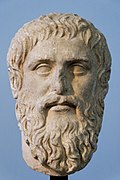
 Plato was one of the devoted young followers of Socrates, whose bust is pictured above.

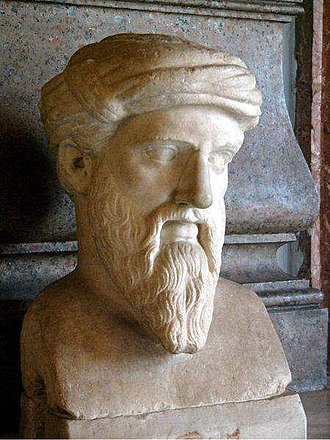 The mathematical and mystical teachings of the followers of Pythagoras, pictured above, exerted a strong influence on Plato.
 Plato's Academy mosaic in the villa of T. Siminius Stephanus in Pompeii, around 100 BC to 100 CE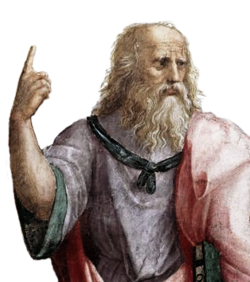
 "What is justice?" forms one of the core quandaries of the Republic.
In their own words 10
 ,
, I shall assume that your silence gives consent.
No man of sense can put himself and his soul under the control of names... You must consider courageously and thoroughly and not accept anything carelessly.
Wonder is the feeling of a philosopher, and philosophy begins in wonder.
Family
Parents
PlatoBrothers and sisters
Is this everyone?
Only relatives with a profile here are drawn, so a family can be larger than this. A line here can also be wrong.
Correct this familyAbout this person
Born around 428-423 BC in Classical Athens, Plato absorbed the pre-Socratic puzzles of Pythagoras, Heraclitus, and Parmenides before studying under Socrates. After his teacher's execution, he founded the Academy, where he taught what would become Platonism and trained Aristotle. His complete works survived when nearly every contemporary's vanished, read straight through antiquity and the Middle Ages, shaping Christian, Jewish, and Islamic thought through Neoplatonism. He died in 348 or 347 BC, leaving a body of work so encompassing that Alfred North Whitehead later called European philosophy "a series of footnotes to Plato."
Fame.am measures public visibility signals. It does not measure human value, talent, morality, or credibility.