Gautama Buddha
Indian philosopher and the founder of Buddhism (623 or 563 BCE - 543 or 483 BCE) · Academics · Lived 500 BC to 500 BC · aged 0
Gautama Buddha is read about 8,013 times a day, in 219 languages.
A typical day, 30 days to 15 October 2026
The middle day of the days counted, so one week of news cannot move it. The line under it is the last 390 days, one point a day.
Something wrong?He walked away from a royal household, sat under a tree until he grasped the mechanics of suffering, and spent forty-five years teaching a path out of it. What he called the Middle Way - between indulgence and self-torment - became the foundation of Buddhism, now practiced across Asia and beyond.
Also in Deutsch
Photos 12


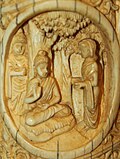
 The Buddha, Tapa Shotor monastery in Hadda, Afghanistan, 2nd century CE

![The "Isapur Buddha", probably the earliest known representation of the Buddha (possibly together with the Butkara seated Buddha statue at the Butkara Stupa, Swat), on a railing post, dated to circa 15 CE.[57]](https://upload.wikimedia.org/wikipedia/commons/thumb/9/9b/Isapur_Buddha.jpg/1280px-Isapur_Buddha.jpg) The "Isapur Buddha", probably the earliest known representation of the Buddha (possibly together with the Butkara seated Buddha statue at the Butkara Stupa, Swat), on a railing post, dated to circa 15 CE.[57]
The "Isapur Buddha", probably the earliest known representation of the Buddha (possibly together with the Butkara seated Buddha statue at the Butkara Stupa, Swat), on a railing post, dated to circa 15 CE.[57] The Relic Stupa of Vaishali, 5th century BCE which held either the Buddha's ashes or part of his relics
 The location of the Shakyas during the time of the Buddha
In their own words 10
 ,
, There are these four ways of answering questions. Which four? There are questions that should be answered categorically [straightforwardly yes, no, this, that].
The tongue is like a sharp knife, it kills without drawing blood; words in the hands of someone skilled can do more damage than a weapon in the hands of a warrior.
Well, Lord, is the soul the same as the body, is the soul one thing and the body another?
Family
Parents

 Gautama Buddha
Brothers and sisters

Is this everyone?
Only relatives with a profile here are drawn, so a family can be larger than this. A line here can also be wrong.
Correct this familyAbout this person
Siddhartha Gautama was born in Lumbini to the Shakya clan in the 6th or 5th century BCE. He renounced his home life to live as a wandering ascetic, practicing mendicancy and meditation until he attained nirvana at Bodh Gaya. Afterward he moved through the lower Indo-Gangetic Plain, teaching and building a monastic order. His core doctrine - the Four Noble Truths and the Noble Eightfold Path - described a training of mind and conduct meant to lead from ignorance and craving to freedom. His followers compiled his teachings into the Vinaya and Sūtra Piṭakas, preserved through oral tradition in Middle Indo-Aryan dialects. Buddhism branched into Theravāda, Mahāyāna, and Vajrayāna, spreading across Asia even as it faded in India after the 8th century. He died in Kushinagar, reaching what the tradition calls parinirvana.
Academics born in the 500s BC 6


Fame.am measures public visibility signals. It does not measure human value, talent, morality, or credibility.