207,380 profiles ranked

Henri Poincaré

French mathematician, physicist and engineer (1854-1912) · France · Academics · Died at 58

Henri Poincaré is read about 1,019 times a day, in 96 languages.

A typical day, 30 days to 15 October 2026

The middle day of the days counted, so one week of news cannot move it. The line under it is the last 390 days, one point a day.

Something wrong?
Compare

He touched every corner of mathematics when it was still possible to know the whole field - and in doing so, stumbled onto chaos. Poincaré's work on the three-body problem revealed that deterministic systems could spin into unpredictability, founding what we now call chaos theory.

A life in dates

1912Died17 July 19121911Bruce MedalAward1910“One evening, contrary to my custom, I drank black coffee and could not sleep.”In their wordsPoincaré, Henri. "Mathematical creation." The Monist (1910): 321-335. Translated from the French by George Bruce Halsted.

1908Member of the Académie françaiseOffice1908-19121906President of the French Academy of SciencesOffice1905“The very possibility of the science of mathematics seems an insoluble contradiction.”In their wordsCh. I: On the Nature of Mathematical Reasoning (1905) Tr. George Bruce Halstead

“There is no science apart from the general. It may even be said that the very object of the exact sciences is to spare us these direct verifications.”In their wordsCh. I. (1905) Tr. George Bruce Halstead

“We can not... escape the conclusion that the rule of reasoning by recurrence is irreducible to the principle of contradiction.”In their wordsCh. I. (1905) Tr. George Bruce Halstead

“But, one will say, if raw experience can not legitimatize reasoning by recurrence, is it so of experiment aided by induction?”In their wordsCh. I. (1905) Tr. George Bruce Halstead

Bolyai PrizeAwardMatteucci MedalAwardRoyal Order of the Polar StarAward1904“We do not have and cannot have any means of discovering whether or not we are carried along in a uniform motion of translation.”In their wordsL’état actuel et l’avenir de la physique mathematique (1904)

1903Commander of the Legion of HonourAward1901Sylvester MedalAward1900Gold Medal of the Royal Astronomical SocietyAwardPresident of the Mathematical Society of FranceOffice1896Jean Reynaud PrizeAward1894Foreign Member of the Royal SocietyAward1886President of the Mathematical Society of FranceOffice1885Poncelet PrizeAward1873Concours généralAward1854Born29 April 1854

Also in Deutsch

Photos 8

In their own words 10
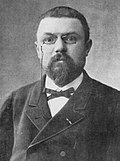
,
Henri Poincaré
,
10 statements, newest first
  1. One evening, contrary to my custom, I drank black coffee and could not sleep.

    1910, Poincaré, Henri. "Mathematical creation." The Monist (1910): 321-335. Translated from the French by George Bruce Halsted., Own words

  2. The very possibility of the science of mathematics seems an insoluble contradiction.

    1905, Ch. I: On the Nature of Mathematical Reasoning (1905) Tr. George Bruce Halstead, Own words

  3. There is no science apart from the general. It may even be said that the very object of the exact sciences is to spare us these direct verifications.

    1905, Ch. I. (1905) Tr. George Bruce Halstead, Own words

Wikiquote, CC BY-SA 4.0

Awards

Bruce Medal1911
Bolyai Prize1905
Matteucci Medal1905
Royal Order of the Polar Star1905
Commander of the Legion of Honour1903
Sylvester Medal1901
Gold Medal of the Royal Astronomical Society1900
Jean Reynaud Prize1896
Foreign Member of the Royal Society1894
Poncelet Prize1885
Concours général1873

Family

Is this everyone?

Only relatives with a profile here are drawn, so a family can be larger than this. A line here can also be wrong.

Correct this family

About this person

Born 29 April 1854, Jules Henri Poincaré trained as a mathematician, physicist, and engineer, then proceeded to leave his mark on pure math, applied math, celestial mechanics, and the philosophy of science in equal measure. His research on the three-body problem led him to discover chaotic deterministic systems, laying the groundwork for chaos theory; he created the field of algebraic topology, introduced automorphic forms, and in the early 20th century posed the Poincaré conjecture - unsolved for a century until Grigori Perelman cracked it in 2002-2003. He was first to present the Lorentz transformations in modern symmetrical form, discovered the remaining relativistic velocity transformations in a 1905 letter to Hendrik Lorentz, and wrote foundational papers that year on what became special relativity; he proposed gravitational waves in 1905 and in 1912 published an influential mathematical argument for quantum mechanics. Contemporaries called him "the living brain of the rational sciences." He died 17 July 1912.

Country
France
Category
Academics
Type
Academic
Status
deceased
Dates
Lived 1854 to 1912 · aged 58

Fame.am measures public visibility signals. It does not measure human value, talent, morality, or credibility.