Emanuel Lasker
Former World Chess champion (1868-1941) · Germany · Chess Players · Died at 72
Emanuel Lasker is read about 513 times a day, in 71 languages.
A typical day, 30 days to 15 October 2026
The middle day of the days counted, so one week of news cannot move it. The line under it is the last 390 days, one point a day.
Something wrong?He held the world chess title for 27 years - longer than anyone in history - and won it six times, yet his opponents couldn't explain how he did it. Where others memorized lines, Lasker played the person across the board.
A life in dates
Also in Deutsch
Photos 8
 Bundesarchiv Bild 102-14194, Emanuel Lasker
 1894 Lasker - Steinitz Title Match
 1896 Lasker - Steinitz Title Match
.jpg?width=1200) American Chess Bulletin Vol. 01 - DPLA - 71c5a7f02c22f16608e340e82662bab6 (page 156)
American Chess Bulletin Vol. 01 - DPLA - 71c5a7f02c22f16608e340e82662bab6 (page 156) Barlinek tablica Laskera
 Botvinnik-Lasker 1936
 Bundesarchiv Bild 102-00457, Emanuel Lasker
 Bundesarchiv Bild 102-00459, Emanuel Lasker
In their own words 5
 ,
, What is immobile must suffer violence.
Education in Chess has to be an education in independent thinking and judgement. Chess must not be memorized, simply because it is not important enough.
You should keep in mind no names, nor numbers, nor isolated incidents, not even results, but only methods. The method is plastic. It is applicable in every situation.
Awards
In their orbit 2
About this person
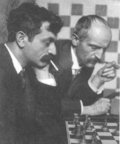
Born in Germany in 1868, Lasker became the second World Chess Champion in 1894 and didn't relinquish the crown until 1921. His peers accused him of deliberately playing bad moves to destabilize opponents, a "psychological" gimmick - but later analysis showed he was simply using a flexible, adaptive style decades ahead of its time. He published five chess books and magazines, though students found his methods hard to distill into lessons. Away from the board, Lasker proved theorems in commutative algebra that bear his name, wrote on bridge and Go, invented a game called Lasca, and posed a card-game problem still studied in combinatorics. He died in New York in 1941, having outlasted his reign.
Chess Players from Germany 2


Fame.am measures public visibility signals. It does not measure human value, talent, morality, or credibility.