Adam Smith
Scottish moral philosopher and political economist (1723-1790) · United Kingdom · Academics · Died at 67
Adam Smith is read about 3,881 times a day, in 171 languages.
A typical day, 30 days to 15 October 2026
The middle day of the days counted, so one week of news cannot move it. The line under it is the last 390 days, one point a day.
Something wrong?He wrote the book that made economics a discipline. The Wealth of Nations dismantled divine explanations for wealth and power, replaced them with markets and self-interest, and gave classical capitalism its intellectual scaffolding.
A life in dates
Also in Deutsch
Photos 8


In their own words 10
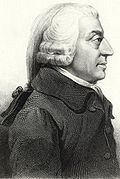 ,
The Union was a measure from which infinite Good has been derived to this country.
Every faculty in one man is the measure by which he judges of the like faculty in another.
Hatred and anger are the greatest poison to the happiness of a good mind.
Awards
About this person
Born in Kirkcaldy and educated at Glasgow and Oxford - one of the few to hold a John Snell scholarship - Smith lectured at Edinburgh to early acclaim, then collaborated with David Hume during the Scottish Enlightenment. He took a professorship at Glasgow teaching moral philosophy, where he published The Theory of Moral Sentiments in 1759. A tutoring post later took him across Europe to meet the era's leading minds. In 1776 he published An Inquiry into the Nature and Causes of the Wealth of Nations, a frontal challenge to mercantilism that laid out division of labor, absolute advantage, and the case for rational self-interest guiding prosperity. The work became the foundation of modern economic thought. Writers like Horace Walpole mocked his style, but the framework held.
Academics from the United Kingdom 6



Fame.am measures public visibility signals. It does not measure human value, talent, morality, or credibility.