William Pitt, 1st Earl of Chatham
Prime Minister of Great Britain from 1766 to 1768 (1708-1778) · Politicians · Died at 69
William Pitt, 1st Earl of Chatham is read about 487 times a day, in 61 languages.
A typical day, 30 days to 16 September 2026
The middle day of the days counted, so one week of news cannot move it. The line under it is the last 60 days, one point a day.
Something wrong?He refused a title for decades, earning the nickname "the Great Commoner," then ran Britain's war machine during the Seven Years' War with a single-minded fixation on crushing France. His power didn't come from birthright - it came from oratory so commanding it bent the House of Commons to his will.
A life in dates
Also in Deutsch
Photos 8
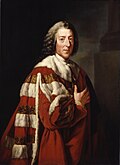
 William Pitt, 1st Earl of Chatham after Richard Brompton
 Hoare - William Pitt, 1st Earl of Chatham
 (Association meeting at York) (BM 1868,0808.4671)
 The Death of the Earl of Chatham by John Singleton Copley
 2023-09-14 79th Regiment Manilla Monument and Monument to William Pitt, Earl of Chatham, in Clifton, City of Bristol
 A crowd of people are gathered on the quayside as small rowi Wellcome V0039883
 A mansion house treat. or Smoking attitudes! (BM 1868,0808.6913 1)
 A mansion house treat. or Smoking attitudes! (BM 1868,0808.6913)
In their own words 10
 ,
America has been conquered in Germany, where Prince Ferdinand's victories have shattered the whole military power of that great military monarchy, France.
No doubt with me that Spain is France [more] than that the Isle of France is, a union in the House of Bourbon; loss of time loss of opportunity.
Pitt complained that we lay inactive, while the French pushed on their conquests.
Awards
Family
Parents
William Pitt, 1st Earl of ChathamPartners

Children


Is this everyone?
Only relatives with a profile here are drawn, so a family can be larger than this. A line here can also be wrong.
Correct this familyAbout this person
William Pitt was born 15 November 1708 and entered Parliament as a Whig who made his name attacking the government - Walpole's corruption in the 1730s, Hanoverian subsidies in the 1740s. From 1756 to 1761, with a brief interlude in 1757, he led the British cabinet through the Seven Years' War, including the French and Indian War in America, his brilliant rhetoric and single-minded devotion to victory over France solidifying Britain's dominance over world affairs. He finally accepted a title in 1766, becoming the 1st Earl of Chatham, and served as Prime Minister from 1766 to 1768, holding the official post of Lord Privy Seal. Out of power for most of his career, he kept attacking: peace with France in the 1760s, policy toward the American colonies in the 1770s, his support for the American position marking his final years. He died 11 May 1778, ranked highly by scholars not for family connections but for the extraordinary parliamentary skills that made him master of the Commons.




Fame.am measures public visibility signals. It does not measure human value, talent, morality, or credibility.