William Laud
Archbishop of Canterbury (1573-1645) · United Kingdom · Academics · Died at 71
William Laud is read about 161 times a day, in 32 languages.
A typical day, 30 days to 17 September 2026
The middle day of the days counted, so one week of news cannot move it. The line under it is the last 60 days, one point a day.
Something wrong?Archbishop of Canterbury under Charles I, arrested by Parliament in 1640 and beheaded five years later - not for treason in the usual sense, but for insisting the English pray a certain way. His name became shorthand for the ceremonial rigidity that split a kingdom.
A life in dates
Also in Deutsch
Photos 8
 William Laud
 Tower Hill Scaffold Site memorial plaque William Laud Harry Vane Algernon Sidney James Duke of Monmouth James Radcliffe Simon Fraser Trinity Square Gardens London England 01
 A speech delivered in the Starr-Chamber, on Wednesday, the XIVth of Iune, MDCXXXVII Fleuron T128369-3
 A speech delivered in the Starr-Chamber, on Wednesday, the XIVth of Iune, MDCXXXVII Fleuron T128369-5
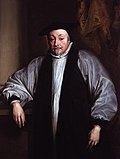
 Anthony van Dyck - Portrait of William Laud (1573-1645), Archbishop of Canterbury, c1635-1637 - Fitzwilliam Museum
 Anthony van Dyck - Portret van William Laud (1573-1645), aartsbisschop van Canterbury - 2043 - Fitzwilliam Museum
 Archbishop Laud
 Canterbury Cathedral JC 09
In their own words 10
 ,
I have been informed that some masters come to St. Mary's, and stand or sit there bare in sermon time, not out of any devotion, but only to hide their hats...
Wednesday, Coronation-day, King Charles took his journey northward, against the Scottish covenanting rebels. God of His infinite mercy bless him with health and success.
No man can set a better state of the question between Scripture and tradition, than Hooker doth.
About this person
William Laud was born in October 1573 and rose through the Church of England as a bishop before Charles I made him Archbishop of Canterbury in 1633. He believed in rule by bishops and drove a reform movement - "Laudianism" - that enforced liturgical ceremony, clerical hierarchy, and uniformity across the church, foreshadowing what would later be called high church practice. Puritans accused him of Arminianism, of covert sympathy for Rome, of standing against Calvinism; they saw him as a threat. When he used the Star Chamber to crush dissenters like William Prynne, he became deeply unpopular. Parliament arrested him in 1640. He was executed in January 1645, near the end of the First English Civil War.
Academics from the United Kingdom 6


Fame.am measures public visibility signals. It does not measure human value, talent, morality, or credibility.