Talcott Parsons
American sociologist (1902 - 1979) · United States · Academics · Died at 76
Talcott Parsons is read about 455 times a day, in 55 languages.
A typical day, 30 days to 8 October 2026
The middle day of the days counted, so one week of news cannot move it. The line under it is the last 74 days, one point a day.
Something wrong?He built the first grand theory of social systems in American sociology - a vast architecture explaining how values, structures, and individual choices lock together to produce the order we call society.
A life in dates
Also in Deutsch
Photos 4


In their own words 10
 ,
The social system is, thus, a very complex entity. As an organization of human interests, activities and commitments, it must be viewed as a system and in functional perspective.
The functions of the family in a highly differentiated society are not to be interpreted as functions directly on behalf of the society, but on behalf of personality.
The most elementary communication is not possible without some degree of conformity to the “conventions” of the symbolic system.
Awards
Family

Is this everyone?
Only relatives with a profile here are drawn, so a family can be larger than this. A line here can also be wrong.
Correct this familyAbout this person
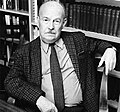
Talcott Parsons arrived at Harvard in 1927 with a PhD in economics and stayed for forty-six years, joining the new sociology department in 1930 and later founding the Department of Social Relations. He translated Max Weber into English and synthesized Weber, Durkheim, and Pareto into something new: social action theory, which argued that cultural values and social structures - not internal psychological drives - constrain and determine human behavior. His structural functionalism dominated English-language sociology from the 1940s through the 1970s, dense and systematic and generalizable across societies. By the end, critics called his work conservative and impenetrable; he himself published a 1975 article rejecting the "structural functionalist" label. He served as president of the American Sociological Association in 1949, spent fifteen years in its leadership, and died in 1979 with his reputation in eclipse - though interest in his ideas has quietly returned.
Academics from the United States 6


Fame.am measures public visibility signals. It does not measure human value, talent, morality, or credibility.