Pol Pot
Former General Secretary of the Communist Party of Kampuchea (1925-1998) · Cambodia · Politicians · Died at 72
Pol Pot is read about 8,519 times a day, in 116 languages.
A typical day, 30 days to 22 October 2026
The middle day of the days counted, so one week of news cannot move it. The line under it is the last 397 days, one point a day.
Something wrong?He ordered the emptying of Cambodia's cities, abolished money and private property, forced an entire nation into labor camps, and oversaw the deaths of approximately 1.5 to 2 million people - roughly a quarter of the population - between 1975 and 1979.
A life in dates
Also in Deutsch
Photos 12


 Prek Sbauv, the village where Pol Pot was born and spent his early years
 Sâr arrived in Paris on 1 October 1949. Paris pictured in 1950.
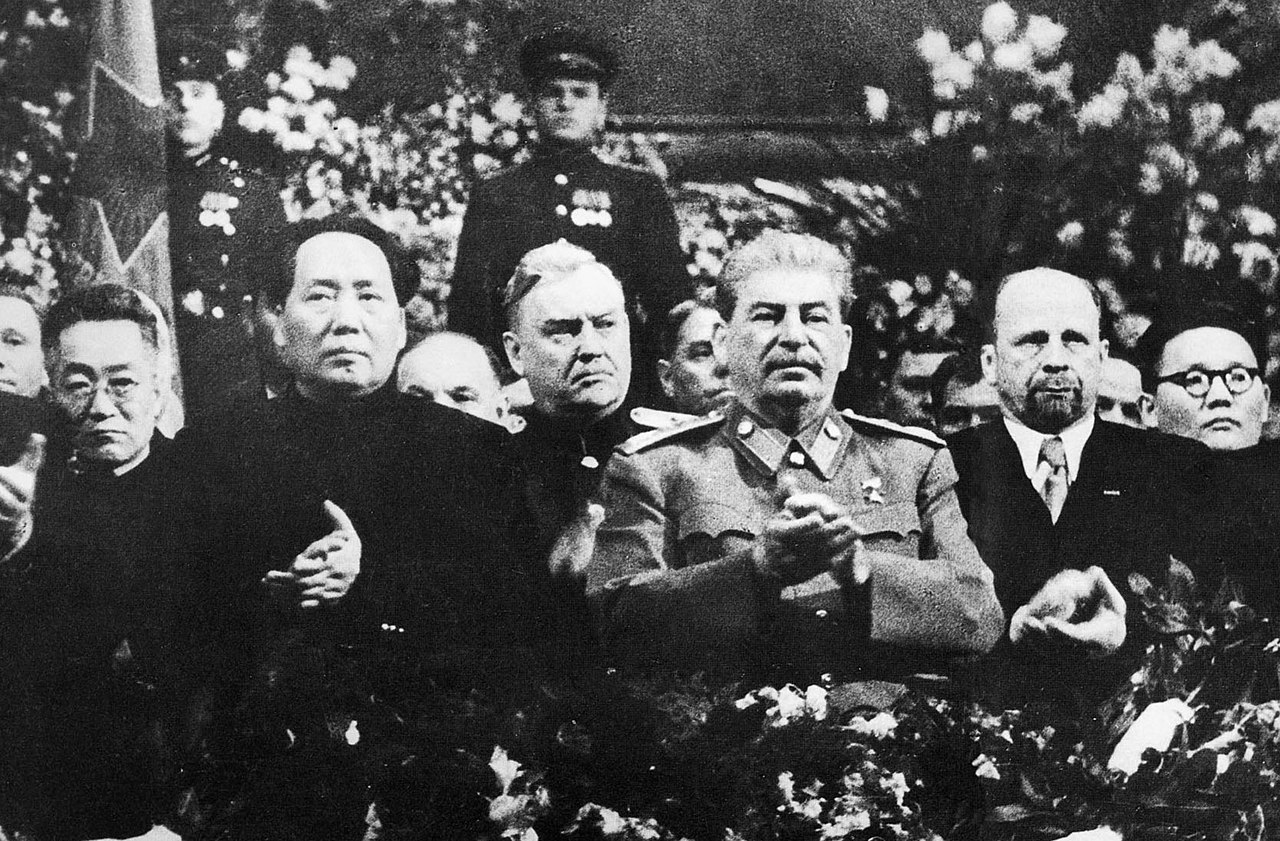 In Paris, Pol Pot was inspired by the writings of Mao Zedong and Joseph Stalin (pictured together in 1949) on how to conduct a revolution.
 King Sihanouk disbanded the Cambodian government and National Assembly before securing independence from French colonial rule in 1953.
 The flag of the Communist Party of Kampuchea, a group whose members were informally known as the "Khmer Rouge"
 In 1970, a U.S. backed coup led to Lon Nol's right-wing dictatorship being installed in Cambodia
In their own words 9
 ,
Everything I did, I did for my country.
First, I would like to tell you that I came to carry out the struggle, not to kill people. Even now, and you can look at me, am I savage person? My conscience is clear.
There's what we did wrong and what we did right.
Awards
Family
Is this everyone?
Only relatives with a profile here are drawn, so a family can be larger than this. A line here can also be wrong.
Correct this familyAbout this person
Born to a prosperous farmer in French Cambodia in 1925, Saloth Sâr attended elite schools before winning a scholarship to Paris in 1949, where he joined the French Communist Party while studying radio electronics. Returning in 1953, he worked as a teacher in Phnom Penh while rising through Cambodia's Marxist-Leninist movement, becoming leader of the Communist Party of Kampuchea in 1963 and retreating to the jungle to wage guerrilla war. After Lon Nol's 1970 coup, his Khmer Rouge forces - backed by North Vietnam - seized control of Cambodia by 1975. He declared "Year Zero" on April 17, 1975: cities were emptied, the population frogmarched to collective farms, and the Killing Fields began - mass executions, forced labor, starvation, and torture that killed over a million in under four years. Vietnam invaded in December 1978, toppling his government within weeks and driving the Khmer Rouge into the jungle, where they fought until 1989. He died under house arrest in 1998, his name synonymous with genocide.
Politicians from Cambodia 6


Fame.am measures public visibility signals. It does not measure human value, talent, morality, or credibility.