Pierre Teilhard de Chardin
French philosopher, Jesuit priest, and paleontologist · France · Academics · Lived 1881 to 1955 · aged 73
Pierre Teilhard de Chardin is read about 867 times a day, in 56 languages.
A typical day, 30 days to 15 October 2026
The middle day of the days counted, so one week of news cannot move it. The line under it is the last 390 days, one point a day.
Something wrong?A Jesuit priest who dug up Peking Man and tried to reconcile Darwin with Genesis - then had his books banned by the Vatican for theological trouble the Holy Office wouldn't name.
A life in dates
Also in Deutsch
Photos 8


In their own words 10
 ,
Through the incarnation God descended into nature in order to super-animate and take it back to him.
Personally, I stick to my idea that we are watching the birth, more than the death, of a World.
There is neither spirit nor matter in the world; the stuff of the universe is spirit-matter. No other substance but this could produce the human molecule.
Awards
Family
Pierre Teilhard de ChardinIs this everyone?
Only relatives with a profile here are drawn, so a family can be larger than this. A line here can also be wrong.
Correct this familyAbout this person
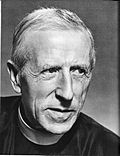
Pierre Teilhard de Chardin was born in France on 1 May 1881 and entered the Jesuits, eventually training as both priest and scientist. He carried stretchers through the First World War, earning the Médaille militaire and the Legion of Honor. His paleontological work took him to China, where he joined the team that discovered Peking Man fossils in the Zhoukoudian caves near Beijing. At the same time he was writing speculative works that blended evolution, Christian mysticism, and ideas borrowed from Henri Bergson - conceiving things like the Omega Point and contributing, with Vladimir Vernadsky, to the concept of the noosphere. In 1962, seven years after his death on 10 April 1955, the Holy Office issued a warning about ambiguities and doctrinal errors in his writings, though it never spelled them out. Scientists have remained split; some popes since have offered measured praise.


Fame.am measures public visibility signals. It does not measure human value, talent, morality, or credibility.