Paul Dirac
British theoretical physicist (1902-1984) · United Kingdom · Scientists · Died at 82
Paul Dirac is read about 1,394 times a day, in 102 languages.
A typical day, 30 days to 15 October 2026
The middle day of the days counted, so one week of news cannot move it. The line under it is the last 390 days, one point a day.
Something wrong?He wrote down an equation in 1928 that married relativity to quantum mechanics and predicted antimatter before anyone had seen it - a leap so clean that physics has been working out the implications ever since.
A life in dates
Also in Deutsch
Photos 8
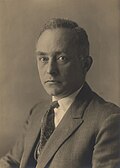
 Paul Dirac, 1933
 15. Tagung 1965 Physiker Paul Dirac an der Tafel - W134Nr.078945 - Willy Pragher
 15. Tagung 1965 Physiker; Maikäferrede Paul Dirac - W134Nr.078981 - Willy Pragher
 Leiden Kamerlingh-Onnes Lab
_bw.jpg?width=1200) Solvay conference 1927 (group photograph) bw
Solvay conference 1927 (group photograph) bw_with_frame.jpg?width=1200) Solvay conference 1927 (group photograph) with frame
Solvay conference 1927 (group photograph) with frame.jpg?width=1200) Solvay conference 1927 (group photograph)
Solvay conference 1927 (group photograph) Solvay conference 1927 restored source
In their own words 10
 ,
, It was a good description to say that it was a game, a very interesting game one could play. Whenever one solved one of the little problems, one could write a paper about it.
I want to emphasize the necessity for a sound mathematical basis for any fundamental physical theory. Any philosophical ideas that one may have play only a subordinate role.
My research work was based in pictures. I needed to visualise things and projective geometry was often most useful e.g.
Awards
Family
Paul DiracPartners
Is this everyone?
Only relatives with a profile here are drawn, so a family can be larger than this. A line here can also be wrong.
Correct this familyAbout this person
Dirac came up through electrical engineering at Bristol, then mathematics, then arrived at Cambridge in 1926 to write the first doctoral thesis on quantum mechanics. Two years later he formulated the Dirac equation, connecting special relativity and quantum mechanics in a way that predicted the existence of antimatter. A 1931 paper sharpened that prediction. He contributed to Fermi-Dirac statistics, which describes particles with half-integer spin, and worked to reconcile general relativity with quantum mechanics. His 1930 monograph, The Principles of Quantum Mechanics, became one of the field's foundational texts. He shared the 1933 Nobel Prize with Schrödinger, held the Lucasian chair at Cambridge from 1932 to 1969, then taught at Florida State until his death in 1984. Hawking later said Dirac had done more than anyone but Einstein to advance physics that century.
In common with Paul


Fame.am measures public visibility signals. It does not measure human value, talent, morality, or credibility.