Charles Darwin
English naturalist and biologist (1809-1882) · United Kingdom · Scientists · Died at 73
Charles Darwin is read about 6,974 times a day, in 211 languages.
A typical day, 30 days to 15 October 2026
The middle day of the days counted, so one week of news cannot move it. The line under it is the last 390 days, one point a day.
Something wrong?He turned a five-year sail around the world into the idea that binds all biology: every living thing shares an ancestor, shaped by the ruthless edit of natural selection. The theory rattled Victorian England and still draws more search traffic than most scientists get in death.
A life in dates
Also in Deutsch
Photos 12

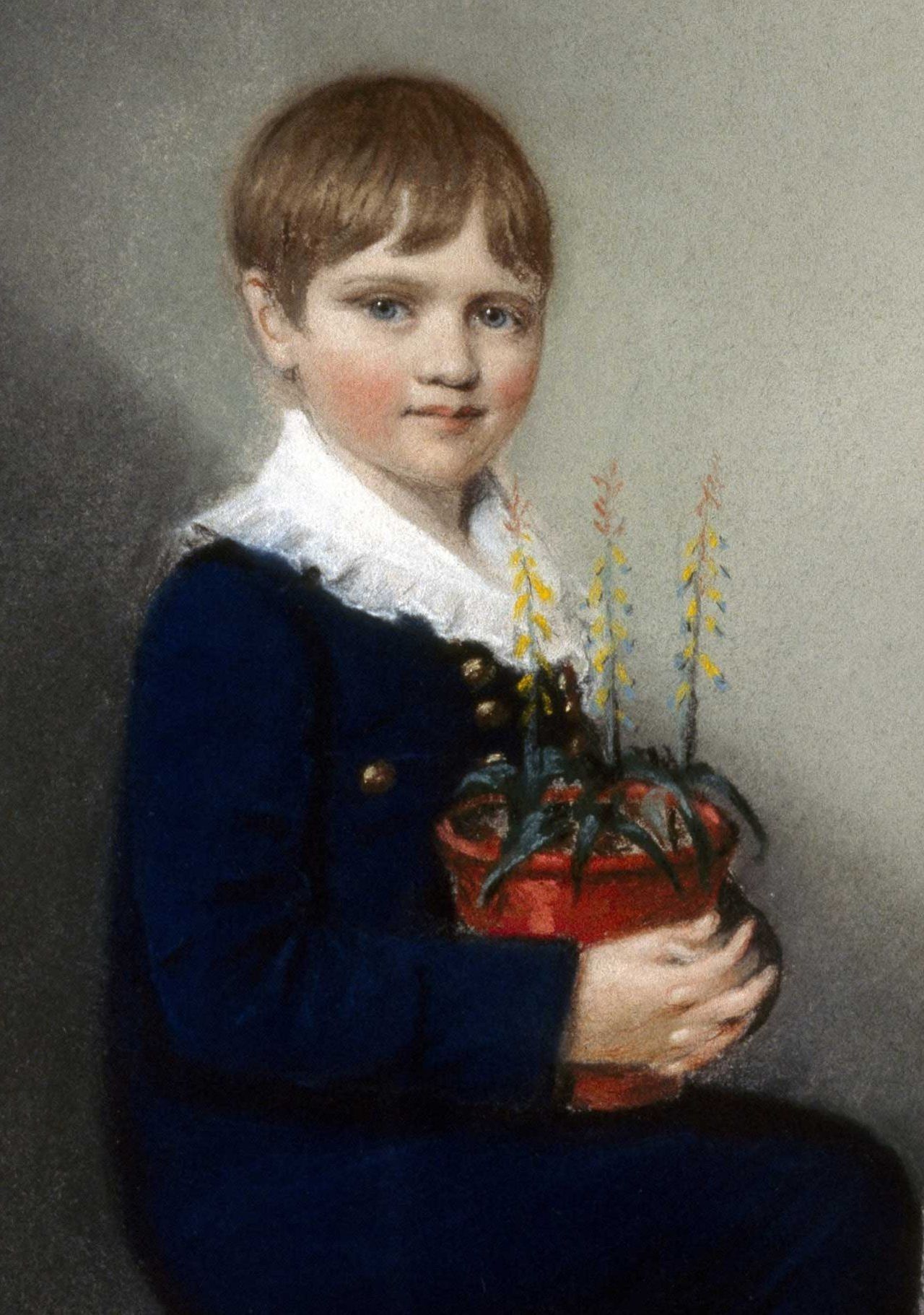 A chalk drawing of the seven-year-old Darwin in 1816, with a potted plant, by Ellen Sharples. Part of a double portrait showing him together with his sister Catherine.
![A bicentennial portrait by Anthony Smith of Darwin as a student, in the courtyard at Christ's College, Cambridge, where he had rooms.[33]](https://upload.wikimedia.org/wikipedia/commons/thumb/5/5b/Young-Charles-Darwin-statue-by-Anthony-Smith-%28Christ%27s-College-Cambridge%29-3.jpg/500px-Young-Charles-Darwin-statue-by-Anthony-Smith-%28Christ%27s-College-Cambridge%29-3.jpg) A bicentennial portrait by Anthony Smith of Darwin as a student, in the courtyard at Christ's College, Cambridge, where he had rooms.[33]
A bicentennial portrait by Anthony Smith of Darwin as a student, in the courtyard at Christ's College, Cambridge, where he had rooms.[33] The round-the-world voyage of the Beagle, 1831-1836
 Darwin (right) on the Beagle's deck at Bahía Blanca in Argentina, with fossils; caricature by Augustus Earle, the initial ship's artist
 As HMS Beagle surveyed the coasts of South America, Darwin theorised about geology and the extinction of giant mammals. Watercolour by the ship's artist Conrad Martens, who replaced Augustus Earle, in Tierra del Fuego.
 While still a young man, Darwin joined the scientific elite; portrait by George Richmond.
In their own words 10
 ,
, Earth-worms abound in England in many different stations.
M. Perrier found that their exposure to the dry air of a room for only a single night was fatal to them.
When a worm is suddenly illuminated and dashes like a rabbit into its burrow - to use the expression employed by a friend - we are at first led to look at the action as a reflex one.
Awards
Family
Parents

 Charles Darwin
Partners

Children


Brothers and sisters

Is this everyone?
Only relatives with a profile here are drawn, so a family can be larger than this. A line here can also be wrong.
Correct this familyAbout this person
Charles Robert Darwin ditched medical school at Edinburgh to poke at marine invertebrates, then landed a berth on HMS Beagle in 1831 for what became a five-year voyage that made him a geologist of note. Puzzled by the fossils and living creatures he'd catalogued across continents, he began sketching a theory of natural selection by 1838 but sat on it for two decades, buried in barnacle taxonomy and coral-reef monographs that won him the Royal Medal in 1853. When Alfred Russel Wallace mailed him an essay describing the same mechanism in 1858, both men rushed their work to the Linnean Society; Darwin followed with On the Origin of Species the next year, then The Descent of Man in 1871, which pulled humans into the branching tree. By the 1870s the educated world accepted evolution as fact, though natural selection didn't become the consensus engine until the mid-twentieth century. He died in 1882 and was buried in Westminster Abbey.
Scientists from the United Kingdom 6




Fame.am measures public visibility signals. It does not measure human value, talent, morality, or credibility.