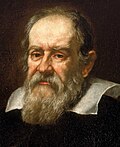
Galileo Galilei
Italian polymath (1564-1642) · Italy · Scientists · Died at 77
Galileo Galilei is read about 8,559 times a day, in 209 languages.
A typical day, 30 days to 15 October 2026
The middle day of the days counted, so one week of news cannot move it. The line under it is the last 390 days, one point a day.
Something wrong?He turned a telescope to the sky and saw moons circling Jupiter, phases on Venus, mountains on our own - then spent his last years locked in his house for saying the Earth moves.
A life in dates
Also in Deutsch
Photos 11


 Portrait believed to be of Galileo's elder daughter Virginia, who was particularly devoted to her father
 "Cannocchiali" telescopes at the Museo Galileo, Florence, suspected to be Galilean telescopes (top: 1610-1630; bottom: 1609-1640)[45]
 An illustration of the Moon from Sidereus Nuncius, published in Venice, 1610
 Map of France presented in 1684, showing the outline of an earlier map (light outline) compared to a new survey conducted using the moons of Jupiter as an accurate timing reference (heavier outline)

In their own words 10
 ,
I am certainly interested in a tribunal in which, for having used my reason, I was deemed little less than a heretic.
It always seems to me extreme rashness on the part of some when they want to make human abilities the measure of what nature can do.
If you could see the earth illuminated when you were in a place as dark as night, it would look to you more splendid than the moon.
Awards
Family
Parents

 Galileo Galilei
Children

Is this everyone?
Only relatives with a profile here are drawn, so a family can be larger than this. A line here can also be wrong.
Correct this familyAbout this person
Born in Pisa in 1564, Galileo studied motion, gravity, pendulums, built thermoscopes and military compasses, then improved the telescope and aimed it up. What he saw - Jupiter's four largest moons, Saturn's rings, the stars of the Milky Way, sunspots, lunar craters - fed his support for Copernican heliocentrism, the idea that Earth orbits the sun. The Roman Inquisition investigated in 1615 and declared his views contradicted scripture. In 1632 his Dialogue Concerning the Two Chief World Systems appeared to mock Pope Urban VIII, alienating both the Pope and the Jesuits who had backed him. The Inquisition tried him, found him "vehemently suspect of heresy", forced a recantation, and placed him under house arrest for the rest of his life. He spent those years writing Two New Sciences, on kinematics and material strength, and died in 1642.




Fame.am measures public visibility signals. It does not measure human value, talent, morality, or credibility.