Nicholas of Cusa is read about 525 times a day, in 67 languages.
A typical day, 30 days to 15 October 2026
The middle day of the days counted, so one week of news cannot move it. The line under it is the last 390 days, one point a day.
Something wrong?A German bishop who argued that true wisdom begins with knowing you cannot know - and then kept going anyway, into astronomy, math, church reform, and the gritty politics of Rome versus the Holy Roman Empire.
A life in dates
Also in Deutsch
Photos 8
 Nicholas of Cusa
 Gebuertshaus vum Nicolaus Cusanus
 San Pietro in Vincoli - Volta 7
 San Pietro in Vincoli - Volta 8
 Andrea bregno (attr.), san pietro tra cardinale niccolò da cusa e l'angelo libertaore (1464 ca.)
 S. Pietro in Vincoli 021
 San Pietro in Vincoli - Tomba del Cardinale Cusano 1
 San Pietro in Vincoli, Nicolaus Cusanus 0
In their own words 10
 ,
Within itself the soul sees all things more truly than as they exist in different things outside itself.
A human society comes together by a general agreement in order to obey its kings.
For we see that man is a civil and political animal, and is naturally inclined to civilization.
About this person
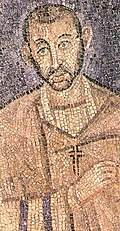
Nicholas of Cusa was born in 1401 in what would become Germany, and became one of the first German voices of Renaissance humanism. He trained as a philosopher, theologian, jurist, mathematician, and astronomer - a polymath in an age that rewarded range. His mystical writings on "learned ignorance" explored the idea that recognizing the limits of human knowledge was itself a form of enlightenment. In 1446 he was dispatched as papal legate to Germany, navigating the power struggles between Rome and the German states. Pope Nicholas V made him cardinal in 1448 for his service, then Prince-Bishop of Brixen two years later. In 1459 he rose to vicar general in the Papal States. He died on 11 August 1464, but the intellectual and political currents he stirred kept moving: in 2001, six hundred years after his birth, scholars on four continents marked the anniversary with conferences and books.



Fame.am measures public visibility signals. It does not measure human value, talent, morality, or credibility.