Nicholas I of Russia
The 11th Emperor of Russia (1825-1855) · Russia · Models · Lived 1796 to 1855 · aged 58
Nicholas I of Russia is read about 4,310 times a day, in 93 languages.
A typical day, 30 days to 15 October 2026
The middle day of the days counted, so one week of news cannot move it. The line under it is the last 390 days, one point a day.
Something wrong?Autocracy in human form: the iron-willed emperor who crushed revolts from Warsaw to the Caucasus, expanded Russia to 20 million square kilometers, then led it into the Crimean disaster that exposed the rot beneath the polish.
A life in dates
Also in Deutsch
Photos 12

 Portrait of Grand Duke Nicholas Pavlovich (c. 1808), by anonymous painter after Johann Friedrich August Tischbein, located in the Russian Museum, Saint Petersburg
 Parade in Potsdam in 1817 by Franz Krüger. A painting commemorating his visit to Berlin to marry Princess Charlotte of Prussia
 Imperial monogram

 Nicholas I "Family Ruble" (1836) depicting the Tsar on the obverse and his family on the reverse: Tsarina Alexandra Feodorovna (center) surrounded by Alexander II as Tsarevich, Maria, Olga, Nicholas, Michael, Konstantin, and Alexandra
 Nicholas I with Alexander II in Bogdan Willewalde's studio in Saint Petersburg in 1854, oil on canvas, State Russian Museum
 Monument to Nicholas I on St. Isaac's Square
In their own words 5
 ,
The Danubian principalities are in fact an independent State under my protection; that solution may continue.
Neither in the characteristics nor the ways of the Russian is this design to be found. ... The heart of Russia was and will be impervious to it. ...
I wish to base the whole structure and administration of the state on the full power and vigour of the law.
Awards
Family
Parents

 Nicholas I of Russia
Children
 Alexander II of Russia Their record only
 Olga Nikolaevna of Russia
 Grand Duchess Alexandra Nikolaevna of Russia
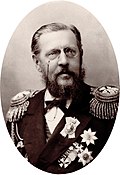 Grand Duke Konstantin Nikolayevich of Russia
 Grand Duke Michael Nikolaevich of Russia
- Grand Duchess Elizabeth Nikolaevna of Russia
 Joséphine Koberwein
- unnamed daughter Romanov
- second unnamed daughter Romanov
- third unnamed daughter Romanov
- Olga Karoline Albrecht
- Aleksey Paskhin
Brothers and sisters


Is this everyone?
Only relatives with a profile here are drawn, so a family can be larger than this. A line here can also be wrong.
Correct this familyAbout this person
Third son of Paul I, Nicholas took the throne in 1825 when the Decembrist revolt tried and failed to stop him. Trained as a military engineer, he saw himself as a soldier obsessed with spit and polish, micromanaging every detail with a nervous, relentless energy. He seized modern Armenia and Azerbaijan from Qajar Iran, helped forge an independent Greece, crushed Poland's November Uprising in 1831, and sent troops to save Austria during the Hungarian Revolution of 1848. Then came the Crimean War in 1853, where his meddling strangled his own generals and the strategy collapsed. He died in 1855 with an empire spanning continents and a legacy historians call "a catastrophic failure in both domestic and foreign policy," leaving a desperate need for the reforms he'd spent twenty-nine years refusing.


Fame.am measures public visibility signals. It does not measure human value, talent, morality, or credibility.