Neil Armstrong
American astronaut and lunar explorer (1930-2012) · United States · Astronauts · Died at 82
Neil Armstrong is read about 6,491 times a day, in 175 languages.
A typical day, 30 days to 15 October 2026
The middle day of the days counted, so one week of news cannot move it. The line under it is the last 390 days, one point a day.
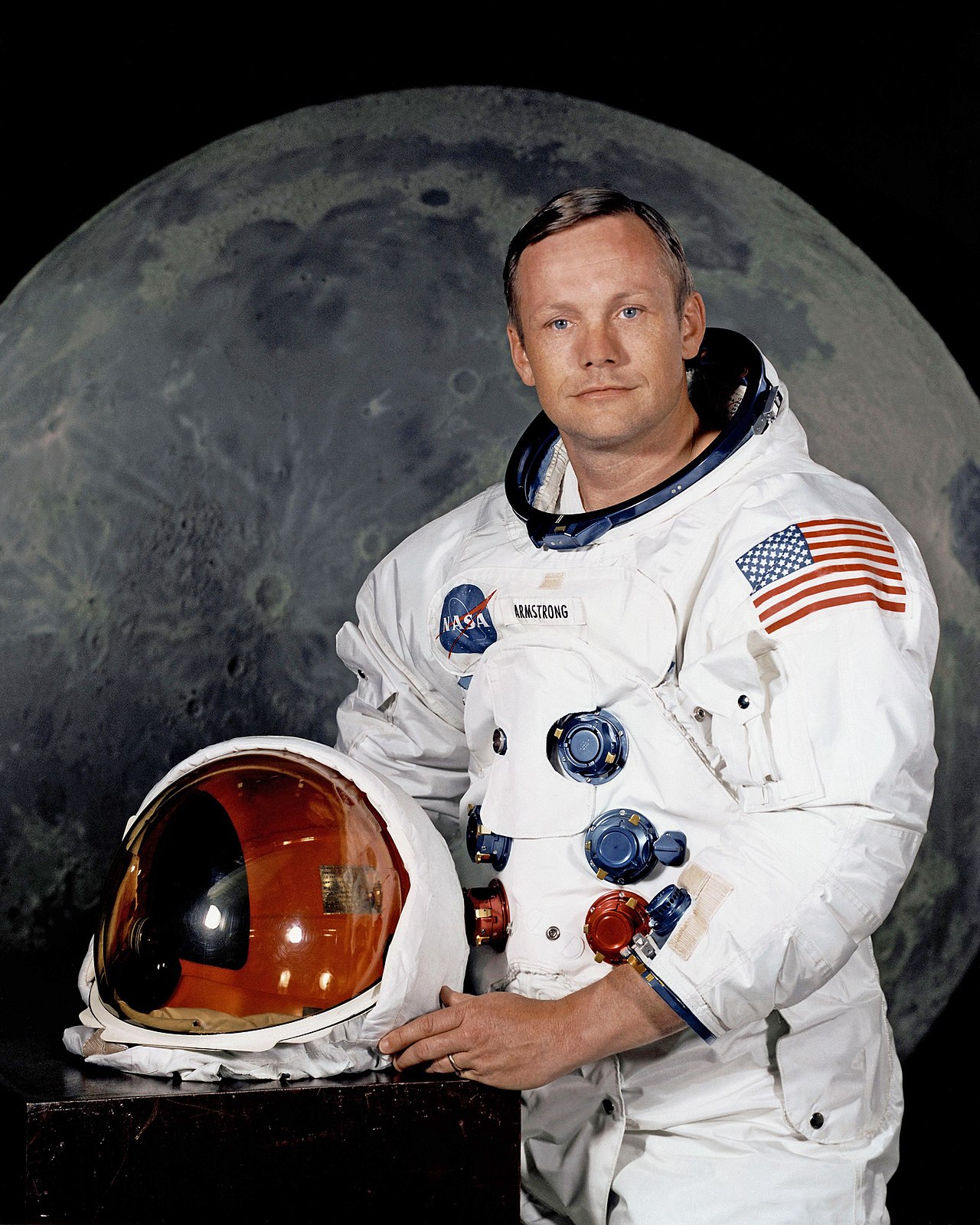
Something wrong?The first human to set foot on the Moon, commander of Apollo 11 in 1969. His step and twelve words were broadcast live to half a billion people - the moment the Space Race became history.
A life in dates
Also in Deutsch
Photos 12


In their own words 10
 ,
The exciting part for me, as a pilot, was the landing on the moon. That was the time that we had achieved the national goal of putting Americans on the moon.
I am comfortable with my level of public discourse.
I remember on the trip home on Apollo 11 it suddenly struck me that that tiny pea, pretty and blue, was the Earth.
Awards
Family
Parents
Neil ArmstrongPartners
Is this everyone?
Only relatives with a profile here are drawn, so a family can be larger than this. A line here can also be wrong.
Correct this familyAbout this person
Armstrong grew up near Wapakoneta, Ohio, studied aeronautical engineering at Purdue on a Navy scholarship, and flew combat missions in Korea from the USS Essex. After the war he became a test pilot at Edwards Air Force Base, flying the X-15 seven times and Century Series fighters. Selected by NASA in 1962, he commanded Gemini 8 in 1966 and performed the first spacecraft docking before a thruster malfunction forced an abort. On July 20, 1969, he and Buzz Aldrin landed on the Moon; the next day they spent two and a half hours outside the lunar module while Michael Collins orbited above. Armstrong resigned from NASA in 1971, taught aerospace engineering at the University of Cincinnati for eight years, and later served on the boards investigating Apollo 13 and the Challenger disaster. He died in 2012 at eighty-two, following coronary bypass surgery.
In common with Neil
 Buzz AldrinAlso in Footprints on the Moon (1969)
 Jeremy ShadaAlso in Quantum Quest: A Cassini Space Odyssey (2010)
 Richard BransonAlso in The Space Movie (1980)
 Michael CollinsAlso in Astronauts Gone Wild: An Investigation Into the Authenticity of the Moon Landings (2004)
 Chris PineAlso in Quantum Quest: A Cassini Space Odyssey (2010)
 Wernher von BraunAlso in Footprints on the Moon (1969)
Fame.am measures public visibility signals. It does not measure human value, talent, morality, or credibility.