Louis de Broglie
Nobel laureate credited to pioneer the discovery of wave character of matter (1892-1987) · France · Scientists · Died at 94
Louis de Broglie is read about 549 times a day, in 94 languages.
A typical day, 30 days to 21 October 2026
The middle day of the days counted, so one week of news cannot move it. The line under it is the last 396 days, one point a day.
Something wrong?He proved that matter behaves like a wave - electrons, atoms, everything solid ripples through space the way light does. The idea sounded like philosophy until experiments bore it out, handed him the Nobel in 1929, and gave quantum mechanics the mathematics it still runs on.
A life in dates
Also in Deutsch
Photos 8
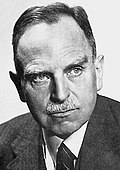
 Prince Louis-Victor de Broglie
_bw.jpg?width=1200) Solvay conference 1927 (group photograph) bw
Solvay conference 1927 (group photograph) bw_with_frame.jpg?width=1200) Solvay conference 1927 (group photograph) with frame
Solvay conference 1927 (group photograph) with frame.jpg?width=1200) Solvay conference 1927 (group photograph)
Solvay conference 1927 (group photograph) Solvay conference 1927 restored source
 Solvay conference 1927 restored
 Solvay conference 1927 Version2
 Solvay conference 1927 Wikivoyage banner
In their own words 3
 ,
, Two seemingly incompatible conceptions can each represent an aspect of the truth … They may serve in turn to represent the facts without ever entering into direct conflict.
It seems a little paradoxical to construct a configuration space with the coordinates of points which do not exist.
The actual state of our knowledge is always provisional and … there must be, beyond what is actually known, immense new regions to discover.
Awards
Family
Louis de BroglieBrothers and sisters

Is this everyone?
Only relatives with a profile here are drawn, so a family can be larger than this. A line here can also be wrong.
Correct this familyAbout this person
Louis Victor Pierre Raymond, 7th Duc de Broglie, was a French theoretical physicist and aristocrat who in his 1924 Ph.D. thesis postulated that electrons have wave nature and all matter has wave properties - the de Broglie hypothesis, a pillar of wave-particle duality. Experimental confirmation came in 1927, earning him the Nobel Prize in Physics in 1929 and George Paget Thomson and Clinton Davisson the same prize a decade later. Erwin Schrödinger used de Broglie's wave theory to build wave mechanics; de Broglie himself presented the pilot-wave concept at the 1927 Solvay Conferences, then abandoned it until David Bohm revived the idea in 1952, prompting de Broglie to return in 1956 with a new version blending Bohm's work and Jean-Pierre Vigier's. He became the sixteenth member of the Académie française in 1944, served as Perpetual Secretary of the French Academy of Sciences, and was the first high-level scientist to call for a multi-national laboratory - the proposal that led to CERN.




Fame.am measures public visibility signals. It does not measure human value, talent, morality, or credibility.