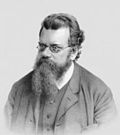
Karl Landsteiner
Jewish-Austrian biologist, physician and Nobel Prize laureate · Austria · Scientists · Lived 1868 to 1943 · aged 75
Karl Landsteiner is read about 282 times a day, in 86 languages.
A typical day, 30 days to 15 October 2026
The middle day of the days counted, so one week of news cannot move it. The line under it is the last 390 days, one point a day.
Something wrong?He figured out why blood kills some patients and saves others - the typing system that turned transfusion from gamble into science.
A life in dates
Also in Deutsch
Photos 8
 Karl Landsteiner nobel
 01 Universität Wien Aula NobelpreistraegerInnen derknopfdruecker com
 1160 Montleartstraße 37 - Wilhelminenspital - Pav. 31 - Karl Landsteiner-Gedenktafel IMG 2827
 Gedenktafel Hindenburgdamm 30 (Lichf) Karl Landsteiner
 Heine Plus3 WS-2
 Heine Plus3 WS
 Intersection of Eichhornstrasse and Theaterstrasse looking down Eichhornstrass Würzburg, Bavaria 97070, Germany
 Karl Landsteiner (1868-1943), bas-relief (bronze) in the Arkadenhof of the University of Vienna-
Awards
Family

 Karl Landsteiner
Partners
Is this everyone?
Only relatives with a profile here are drawn, so a family can be larger than this. A line here can also be wrong.
Correct this familyAbout this person
Karl Landsteiner was born in Austria in 1868 and trained as a physician and immunologist. In 1901 he distinguished the main blood groups, developing the modern classification system by identifying agglutinins in blood - the discovery that made safe transfusion possible. In 1909, working with Constantin Levaditi and Erwin Popper, he discovered the polio virus. At 55 he emigrated to New York for professional opportunities, joining the Rockefeller Institute in 1923. In 1937, with Alexander S. Wiener, he identified the Rhesus factor, giving physicians another critical safeguard. He received the Nobel Prize in Physiology or Medicine in 1930 and died in 1943, later posthumously awarded the Lasker Award in 1946.



Fame.am measures public visibility signals. It does not measure human value, talent, morality, or credibility.