Hippocrates
Ancient Greek physician (c. 460 - c. 370 BCE) · Doctors · Lived 460 BC to 370 BC · aged 90
Hippocrates is read about 2,265 times a day, in 125 languages.
A typical day, 30 days to 27 October 2026
The middle day of the days counted, so one week of news cannot move it. The line under it is the last 400 days, one point a day.
Something wrong?The ancient Greek physician who pulled medicine out of the realm of priests and philosophers and made it a profession grounded in observation. Twenty-five centuries later, doctors still swear oaths attributed to him.
Also in Deutsch
Photos 7
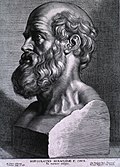
 Hippocrates rubens
 'Hippocrates examining urine' Wellcome L0011166
 A piece of apparatus that is used to manipulate dislocated s Wellcome V0016768
 A triumphal arch from which is suspended the flayed skin of Wellcome V0010438
 An alchemist reading a book; his assistants stirring the cru Wellcome V0025536
 Ancient Greek massage
 Avicenna, Libri canonis. Wellcome L0023858
In their own words 10
 ,
Time is that wherein there is opportunity, and opportunity is that wherein there is no great time. Healing is a matter of time, but it is sometimes also a matter of opportunity.
Conclusions which are merely verbal cannot bear fruit, only those do which are based on demonstrated fact. For affirmation and talk are deceptive and treacherous.
Everything in excess is opposed to nature.
Family
Is this everyone?
Only relatives with a profile here are drawn, so a family can be larger than this. A line here can also be wrong.
Correct this familyAbout this person
Hippocrates of Kos lived from roughly 460 to 370 BC, a Greek physician and philosopher named after his grandfather. He and his school revolutionized medicine by separating it from theurgy and philosophy, establishing it as a distinct discipline built on prognosis, clinical observation, and the systematic categorization of diseases. His work laid groundwork for specialties including surgery, urology, neurology, and orthopedics, though his humoral theory was later discredited. The Hippocratic Corpus, works associated with him, codified the medical knowledge of earlier schools and set standards for acceptable practice. He's credited with the Hippocratic Oath still in use today, though very little is known concretely about what he himself thought or wrote - his achievements blurred with those of the many practitioners and writers who followed his method.
Fame.am measures public visibility signals. It does not measure human value, talent, morality, or credibility.