John Rawls
American political philosopher (1921-2002) · United States · Academics · Died at 81
John Rawls is read about 1,177 times a day, in 68 languages.
A typical day, 30 days to 15 October 2026
The middle day of the days counted, so one week of news cannot move it. The line under it is the last 390 days, one point a day.
Something wrong?He asked what society you'd build if you didn't know whether you'd be born rich or poor, powerful or powerless. That thought experiment - the "original position" - anchored the most influential work of political philosophy in half a century.
A life in dates
Also in Deutsch
Photos 6


In their own words 10
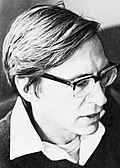 ,
This is a long book, not only in pages.
I am particularly grateful to Nozick for his unfailing help and encouragement during the last stages.
Justice is the first virtue of social institutions, as truth is of systems of thought.
Awards
Family
John RawlsPartners
Is this everyone?
Only relatives with a profile here are drawn, so a family can be larger than this. A line here can also be wrong.
Correct this familyAbout this person
John Bordley Rawls was born February 21, 1921, and spent his career working in moral, legal, and political philosophy within the modern liberal tradition. When A Theory of Justice appeared in 1971, it resurrected normative political philosophy as a serious discipline; the book argued for "justice as fairness" - equal basic liberties, equality of opportunity, and arranging inequalities to benefit the least advantaged. His method was the "original position," a thought experiment in which people choose principles for society without knowing their future place in it. Political Liberalism followed in 1993, tackling how legitimate political power works when citizens hold incompatible moral and religious views. In 1999 he received the Schock Prize and the National Humanities Medal from President Clinton, and by 2008 American political theorists ranked him first for impact on the field in the prior two decades. He died November 24, 2002.
In common with John
 Robert A. DahlBoth received Spitz Prize
 Thomas NagelBoth received Rolf Schock Prize in Logic and Philosophy
 Martha NussbaumBoth received Spitz Prize
 Michael DummettBoth received Rolf Schock Prize in Logic and Philosophy
 Saul KripkeBoth received Rolf Schock Prize in Logic and Philosophy
 Joseph RazBoth received Spitz Prize
Fame.am measures public visibility signals. It does not measure human value, talent, morality, or credibility.