John Quincy Adams
President of the United States from 1825 to 1829 · United States · Politicians · Lived 1767 to 1848 · aged 80
John Quincy Adams is read about 3,022 times a day, in 140 languages.
A typical day, 30 days to 15 October 2026
The middle day of the days counted, so one week of news cannot move it. The line under it is the last 390 days, one point a day.
Something wrong?The only man to leave the presidency and come back to Congress as a regular member - where he spent the next seventeen years fighting slavery louder than he ever governed, collapsing on the House floor in 1848 mid-battle.
A life in dates
Also in Deutsch
Photos 8
 John Q. Adams-edit
 1834 EssexRegister SalemMA 24April
 Adams' Burial Site 002
.jpg?width=1200) ADAMS, John Quincy (signed check)
ADAMS, John Quincy (signed check) American Legation at Copenhagen Pair Inlaid Chairs
 American Pocket Library of Useful Knowledge - John Quincy Adams
 Amistad Correspondence
 Battle scene surrounded by portraits of American presidents LCCN2014646398
In their own words 10
 ,
, 30th [June 1841]. Morning visit from John Ross, chief of the Cherokee Nation, with Vann and Benn, two others of the delegation.
In charity to all mankind, bearing no malice or ill will to any human being, and even compassionating those who hold in bondage their fellow men, not knowing what they do.
Why is it that, next to the birth day of the Saviour of the World, your most joyous and most venerated festival returns on this day?
Awards
Family
Parents
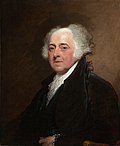
 John Quincy Adams
Partners

Children


Brothers and sisters


Is this everyone?
Only relatives with a profile here are drawn, so a family can be larger than this. A line here can also be wrong.
Correct this familyAbout this person
Born in 1767, the eldest son of John Adams, he grew up trailing his father through European diplomacy during the Revolution. He built a legal career in Boston before Washington sent him abroad as minister to the Netherlands and Prussia. Recalled by Jefferson in 1801, he won a Senate seat but broke with the Federalists over foreign policy and lost re-election. Madison dispatched him to Russia, then Britain, where he brokered the Treaty of Ghent ending the War of 1812. As Monroe's secretary of state he negotiated the Adams-Onís Treaty that brought Florida into the Union and helped shape the Monroe Doctrine. The 1824 election sent him to the White House after a House vote and a deal with Henry Clay that opponents branded a "corrupt bargain." His presidency stalled; Congress blocked his infrastructure and education plans, and Jackson crushed him in 1828. In 1830 he returned to Washington as a congressman and never left, joining the Whigs and turning his final years into a crusade against slavery, the gag rule, and the Mexican War. At seventy-three he argued the Amistad case before the Supreme Court and won. He died at his desk in the Capitol in 1848.
Politicians from the United States 6


Fame.am measures public visibility signals. It does not measure human value, talent, morality, or credibility.