Johannes Diderik van der Waals
Dutch physicist (1837-1923) · Netherlands · Scientists · Died at 85
Johannes Diderik van der Waals is read about 190 times a day, in 95 languages.
A typical day, 30 days to 15 October 2026
The middle day of the days counted, so one week of news cannot move it. The line under it is the last 390 days, one point a day.
Something wrong?He began as a schoolteacher and ended up rewriting the physics of matter itself. Van der Waals proved molecules were real when most scientists still doubted it, then built an equation that let researchers finally turn gases like helium into liquids - and accidentally opened the door to superconductivity.
Also in Deutsch
Photos 8
 Van der Waals
 Heike Kamerlingh Onnes and Johannes Diderik van der Waals
 Grab Johann Diederik van der Waals
 Heike Kamerlingh Onnes - 10 - Johannes Diderik van der Waals (1837-1923), around 35 years old
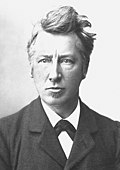
 Johannes Diderik van der Waals (cropped)
 Johannes Diderik van der Waals
 Johannes Diderik van-der-Waals
 Koninklijke Akademie van Wetenschappen; zitting der afdeling Wis- en Natuurkunde
Awards
Family
 Johannes Diderik van der Waals
Partners
Children


Is this everyone?
Only relatives with a profile here are drawn, so a family can be larger than this. A line here can also be wrong.
Correct this familyAbout this person
Johannes Diderik van der Waals was a Dutch theoretical physicist born 23 November 1837, who started his career teaching school before becoming the first physics professor at the University of Amsterdam in 1877. In his 1873 thesis, he tackled the problem of real gases behaving differently than ideal theory predicted, introducing an equation of state that accounted for the finite volume of molecules and the forces between them - at a time when many physicists, led by Ernst Mach and Wilhelm Ostwald, denied molecules even existed. His equation revolutionized the field: it affirmed the reality of molecules, allowed scientists to estimate their size and attraction, and gave them the tools to predict the critical points at which gases liquify. That work enabled the liquefaction of nitrogen, oxygen, hydrogen, and helium - Heike Kamerlingh Onnes used van der Waals's insights to make liquid helium in 1908, which led directly to the 1911 discovery of superconductivity. Van der Waals received the Nobel Prize in Physics in 1910 and died 8 March 1923, his name now attached to the forces, molecules, and radius that define molecular science.



Fame.am measures public visibility signals. It does not measure human value, talent, morality, or credibility.