James Madison
President of the United States from 1809 to 1817 (1751-1836) · United States · Politicians · Died at 85
James Madison is read about 3,315 times a day, in 144 languages.
A typical day, 30 days to 15 October 2026
The middle day of the days counted, so one week of news cannot move it. The line under it is the last 390 days, one point a day.
Something wrong?He wrote the blueprint. Madison arrived at the Constitutional Convention in 1787 with a plan to scrap the Articles of Confederation and build a stronger republic, then co-authored The Federalist Papers to sell it. The fourth president, but the first architect.
A life in dates
Also in Deutsch
Photos 8
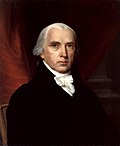
 James Madison
 04 james madison
 64-103-B Certificate, Appointment (13311566615)
 Auction President James Madison's Library
 Battle scene surrounded by portraits of American presidents LCCN2014646398
 Bodleian Libraries, A sketch for the Regents speech on Madassson's insanity
 Bodleian Libraries, Boney and Maddy gone to pot
 Bodleian Libraries, John Bull making a capital bonfire Mr Madison running away by the light of it
In their own words 10
 ,
The papers inclosed will shew that the nauseous project of amendments has not yet been either dismissed or despatched.
Wherever the real power in a Government lies, there is the danger of oppression.
In time of actual war, great discretionary powers are constantly given to the Executive Magistrate.
Awards
Family
Parents
 James Madison
Partners

Is this everyone?
Only relatives with a profile here are drawn, so a family can be larger than this. A line here can also be wrong.
Correct this familyAbout this person
Born March 16, 1751, into a Virginia planter family that held slaves, Madison joined the Patriots in 1774 and served in the Continental Congress during the Revolutionary War. Dissatisfied with the weak national government, he organized the Constitutional Convention where his Virginia Plan shaped the debate, then teamed with Hamilton and Jay to write The Federalist Papers urging ratification. He broke with Hamilton in the 1790s over centralization, co-founding the Democratic-Republican Party with Jefferson, whose Secretary of State he became in 1801. Elected president in 1808, he led the country into the War of 1812 after diplomacy failed to stop British seizures of American goods - motivated partly by a hunger for land held by Britain, Spain, and Native tribes. The war ended inconclusively in 1815 but convinced him a stronger federal government was necessary, and he presided over the Second Bank and a protective tariff while the United States took 26 million acres from Native Americans. He retired to his plantation Montpelier in 1817, freed one slave decades earlier to prevent a rebellion, freed none in his will, and died there in 1836.
Politicians from the United States 6





Fame.am measures public visibility signals. It does not measure human value, talent, morality, or credibility.