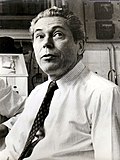
Jacques Monod
French biologist and biochemist, Nobel laureate (1910-1976) · France · Doctors · Died at 66
Jacques Monod is read about 187 times a day, in 66 languages.
A typical day, 30 days to 15 October 2026
The middle day of the days counted, so one week of news cannot move it. The line under it is the last 390 days, one point a day.
Something wrong?He cracked how a cell decides which proteins to make and when to make them - the genetic switch that turns genes on or off. That work on a humble bacterium and a sugar called lactose opened the entire field of gene regulation.
A life in dates
Also in Deutsch
Photos 5


In their own words 5
 ,
The first scientific postulate is the objectivity of nature: nature does not have any intention or goal.
One day, almost exactly 25 years ago - it was at the beginning of the bleak winter of 1940 - I entered ’s office at the Pasteur Institute.
There is in science, however, quite a gap between belief and certainty.
Awards
Family
Parents
Jacques MonodPartners
Is this everyone?
Only relatives with a profile here are drawn, so a family can be larger than this. A line here can also be wrong.
Correct this familyAbout this person
Jacques Lucien Monod was born in France on 9 February 1910 and trained as a biochemist. Working with François Jacob on E. coli and the lac operon, he built a model showing that a repressor protein binds to a specific DNA site - the operator - and blocks the manufacture of enzymes needed to break down lactose. The insight revealed the first clear system for how transcription gets regulated: genes aren't always on, they answer to molecular switches. Monod also proposed the existence of messenger RNA, the middleman carrying instructions from DNA to protein. He shared the 1965 Nobel Prize in Physiology or Medicine with Jacob and André Lwoff for discoveries on genetic control of enzyme and virus synthesis. He died on 31 May 1976, recognised as one of the founders of molecular biology.




Fame.am measures public visibility signals. It does not measure human value, talent, morality, or credibility.