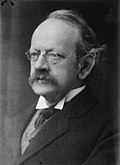
J. J. Thomson
British physicist (1856-1940) · United Kingdom · Scientists · Died at 83
J. J. Thomson is read about 1,128 times a day, in 108 languages.
A typical day, 30 days to 15 October 2026
The middle day of the days counted, so one week of news cannot move it. The line under it is the last 390 days, one point a day.
Something wrong?He cracked open the atom. In 1897, J. J. Thomson proved that cathode rays were streams of tiny, negatively charged particles - electrons - the first subatomic particle anyone had seen. The discovery rewrote matter itself.
A life in dates
Also in Deutsch
Photos 8


In their own words 1
 ,
, The difficulties which would have to be overcome to make several of the preceding experiments conclusive are so great as to be almost insurmountable.
Awards
Family
Parents
J. J. ThomsonPartners
Children

Is this everyone?
Only relatives with a profile here are drawn, so a family can be larger than this. A line here can also be wrong.
Correct this familyAbout this person
Joseph John Thomson was born on 18 December 1856 in Britain. In 1897, his cathode ray experiments revealed particles much smaller than atoms with an enormous charge-to-mass ratio: electrons, the first subatomic building blocks. The work earned him the 1906 Nobel Prize in Physics. He later turned to canal rays and positive ions, finding the first evidence for isotopes of a stable element in 1912 and pioneering mass spectrometry with Francis William Aston. Seven of his students won Nobels, including Ernest Rutherford and his own son, George Paget Thomson. He died on 30 August 1940, having taught a generation that dismantled the atom he'd first opened.
In common with J.


Fame.am measures public visibility signals. It does not measure human value, talent, morality, or credibility.