George Paget Thomson
English physicist (1892-1975) · United Kingdom · Scientists · Died at 83
George Paget Thomson is read about 120 times a day, in 78 languages.
A typical day, 30 days to 21 October 2026
The middle day of the days counted, so one week of news cannot move it. The line under it is the last 396 days, one point a day.
Something wrong?He proved the electron behaves as a wave - two decades after his father won the Nobel for proving it's a particle.
A life in dates
Also in Deutsch
Photos 8
 George Paget Thomson
 15. Tagung 1965 Physiker; Maikäferrede- Sir George P. Thomson - LABW - Staatsarchiv Freiburg W 134 Nr. 078952b
 15. Tagung 1965 Physiker; Maikäferrede- Sir George P. Thomson - LABW - Staatsarchiv Freiburg W 134 Nr. 078952c2
 15. Tagung 1965 Physiker; Maikäferrede- Sir George P. Thomson an der Tafel - LABW - Staatsarchiv Freiburg W 134 Nr. 078957a
 15. Tagung 1965 Physiker; Maikäferrede- Sir George P. Thomson an der Tafel - LABW - Staatsarchiv Freiburg W 134 Nr. 078957b
 15. Tagung 1965 Physiker; Maikäferrede- Sir George P. Thomson an der Tafel - LABW - Staatsarchiv Freiburg W 134 Nr. 078957c
 15. Tagung 1965 Physiker; Maikäferrede- Sir George P. Thomson mit Kopfhörern - LABW - Staatsarchiv Freiburg W 134 Nr. 078960
 15. Tagung 1965 Physiker; Maikäferrede- Sir George P. Thomson, im Hintergrund Ehepaar Paul Dirac - LABW - Staatsarchiv Freiburg W 134 Nr. 078976
Awards
Family
Parents
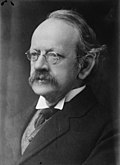
 George Paget Thomson
Partners
Children
Is this everyone?
Only relatives with a profile here are drawn, so a family can be larger than this. A line here can also be wrong.
Correct this familyAbout this person
George Paget Thomson was born in 1892, son of the physicist who'd discovered the electron itself. He spent his career in experimental physics, working with crystalline materials and electron beams. In 1927, firing electrons through thin metal films, he observed diffraction patterns - the signature of wave behavior - in the very particles his father had characterized as discrete corpuscles. The finding, arrived at independently alongside Clinton Davisson's work in the U.S., confirmed de Broglie's theory of matter waves and earned Thomson half the 1937 Nobel Prize in Physics. He died in 1975, having spent a lifetime reconciling what his father had discovered with what he himself had shown: that the electron is both.
Scientists from the United Kingdom 6


Fame.am measures public visibility signals. It does not measure human value, talent, morality, or credibility.