Hugo Grotius
Dutch jurist and scholar (1583-1645) · Netherlands · Academics · Died at 62
Hugo Grotius is read about 683 times a day, in 76 languages.
A typical day, 30 days to 15 October 2026
The middle day of the days counted, so one week of news cannot move it. The line under it is the last 390 days, one point a day.
Something wrong?He escaped prison hidden in a book chest, then from exile wrote the treatises that invented international law as a field. Grotius turned the chaos of sovereignty and war into a system of mutual agreement - the intellectual architecture behind the Peace of Westphalia and every treaty since.
Also in Deutsch
Photos 8
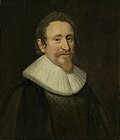
 Portret van Hugo de Groot (1583-1645) Rijksmuseum SK-A-581
 AcademiegebouwLeiden2
 Acht kamers in Slot Loevestein en portretten van vijf gevangenen, RP-P-2019-1646
 Album amicorum of Ernst Brinck I - Hugo de Groot - 133M86 (225r)
 Beleg van Hulst (1591) door Maurits - Siege of Hulst by Prince Maurice (1591) by Pieter Bast
 Blad met biografische gegevens over Hugo de Groot, RP-P-OB-80.964
 Brief van Hugo de Groot aan Joost van den Vondel, RP-P-1905-1703
 Buste van Hugo de Groot gelauwerd door Victoria Het leven en bedryf van den heere Huig de Groot (titel op object) Titelpagina voor Caspar Brandt en Adriaan van Cattenburg, Historie van het leven des heeren Huig de Groo, RP-P-2016-924
In their own words 4
 ,
Liberty is the power that we have over ourselves.
Even God cannot make two times two not make four.
Not to know certain things is a great part of wisdom.
Family
Parents
 Hugo Grotius
Partners

Children

Is this everyone?
Only relatives with a profile here are drawn, so a family can be larger than this. A line here can also be wrong.
Correct this familyAbout this person
Born in Delft in 1583, Hugo Grotius was a teenage prodigy who studied at Leiden and moved through roles as diplomat, jurist, theologian, and poet. His involvement in Dutch religious controversies landed him in Loevestein Castle; he broke out concealed in a chest of books meant for his study and fled to France. There, in exile, he produced his major works: De jure belli ac pacis and Mare Liberum, treatises that laid the foundations for international law by defining a society of states governed not by force but by mutual agreement and actual laws. Grotius also shifted the concept of rights from objects to persons, reframing them as expressions of human capacity. His theological work fed Arminian movements and his ideas on free trade earned him the label "economic theologist." After the First World War, his influence, which had faded, came roaring back.
Academics from the Netherlands 6



Fame.am measures public visibility signals. It does not measure human value, talent, morality, or credibility.