Gustaf V of Sweden
King of Sweden from 1907 to 1950 · Sweden · Historical Figures · Lived 1858 to 1950 · aged 92
Gustaf V of Sweden is read about 1,218 times a day, in 64 languages.
A typical day, 30 days to 15 October 2026
The middle day of the days counted, so one week of news cannot move it. The line under it is the last 390 days, one point a day.
Something wrong?He reigned for 43 years, died at 92, and holds the record as Sweden's oldest monarch - yet Gustaf V is remembered less for longevity than for being the last Swedish king to wield actual power, a prerogative he lost after forcing a constitutional crisis in 1914 and never fully recovered.
A life in dates
Also in Deutsch
Photos 6


Awards
Family
Parents


 Gustaf V of Sweden
Partners

Children


Brothers and sisters


Is this everyone?
Only relatives with a profile here are drawn, so a family can be larger than this. A line here can also be wrong.
Correct this familyAbout this person
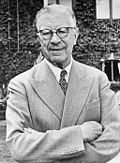
Born the eldest son of Oscar II in 1858, Gustaf V ascended in 1907 and became the first Swedish king since the High Middle Ages to forgo coronation. His early reign collided with the rise of parliamentary rule: in 1914 he dismissed Liberal Prime Minister Karl Staaff and installed his own man, but after the Liberals and Social Democrats won a majority, he bowed to the new government that stripped the monarchy of virtually all power and enacted universal suffrage by 1919. He remained popular for the next three decades, though his pro-German and anti-Communist stances surfaced during both world wars - he allegedly pressed Per Albin Hansson's government to accommodate Nazi logistics requests, fearing invasion, yet personally lobbied Miklos Horthy in 1944 to stop Jewish deportations and supported Raoul Wallenberg's rescue efforts. An avid sportsman, he presided over the 1912 Olympics and competed in tennis under the alias Mr G. well into his eighties. He died in 1950, succeeded by his son Gustaf VI Adolf, having outlasted the royal prerogatives that died with him.


Fame.am measures public visibility signals. It does not measure human value, talent, morality, or credibility.