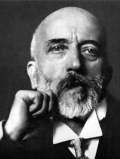
Edmund Husserl
German philosopher, known as the father of phenomenology (*1859 - †1938) · Academics · Died at 79
Edmund Husserl is read about 1,343 times a day, in 83 languages.
A typical day, 30 days to 22 October 2026
The middle day of the days counted, so one week of news cannot move it. The line under it is the last 397 days, one point a day.
Something wrong?He built phenomenology - the attempt to describe consciousness exactly as it appears, before theory or assumption touches it. The method reshaped European philosophy and still runs beneath existentialism, cognitive science, and how we talk about subjective experience.
Also in Deutsch
Photos 8


In their own words 1
 ,
, A new fundamental science, pure phenomenology, has developed within philosophy: This is a science of a thoroughly new type and endless scope.
In their orbit 2
About this person
Husserl trained as a mathematician under Weierstrass and Königsberger, then turned to philosophy with Brentano and Stumpf. Early on he dismantled historicism and psychologism in logic through his analysis of intentionality - the idea that consciousness is always consciousness *of* something. He taught at Halle from 1887, moved to Göttingen in 1901, then Freiburg in 1916. In his mature work he pursued what he called the phenomenological reduction, a method to bracket assumptions and examine how transcendental consciousness sets the bounds of possible knowledge. He retired in 1928 but kept working. In 1933 the Nazi Party's racial laws barred him from the university library because of his Jewish background; he resigned from the Deutsche Akademie months later. He died in Freiburg in 1938 after an illness, leaving a body of work that runs through the century that followed.
Academics born in the 1850s 6




Fame.am measures public visibility signals. It does not measure human value, talent, morality, or credibility.