Diocletian
Augustus of the Eastern Roman Empire (244-311) · Politicians · Lived 240 to 316 · aged 76
Diocletian is read about 2,798 times a day, in 88 languages.
A typical day, 30 days to 15 October 2026
The middle day of the days counted, so one week of news cannot move it. The line under it is the last 390 days, one point a day.
Something wrong?The Roman emperor who split the empire in two, retired to grow vegetables, and launched the bloodiest persecution of Christians in imperial history - none of which went quite as planned.
Also in Deutsch
Photos 8
 Istanbul - Museo archeol. - Diocleziano (284-305 d.C.) - Foto G. Dall'Orto 28-5-2006
 Moneta tetrarchia 285-305
 Prima tetrarchia Diocletianus-zh
 Prima tetrarchia Diocletianus
 Wars-of-the-Tetrarchy-IT
 Complesso Termale Romano in Calabria Terme di Aque Annie Curinga 01
 Complesso Termale Romano in Calabria Terme di Aque Annie Curinga 02
 D299- Division de l’Empire sous Dioclétien -liv3-ch1
Family
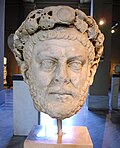 Diocletian
Partners

Children


Is this everyone?
Only relatives with a profile here are drawn, so a family can be larger than this. A line here can also be wrong.
Correct this familyAbout this person
Born Diocles around 242 to a low-status family in Dalmatia, he rose through the legions as a cavalry commander until troops proclaimed him emperor in 284 after his predecessor died on campaign in Persia. He stabilized an empire that had been collapsing through the Third Century by dividing power: Maximian took the West in 286, then two junior Caesars joined in 293, creating the Tetrarchy - rule of four. The system worked while he held it together, with successful campaigns against Persia, the Sarmatians, and usurpers, plus a sweeping reorganization of provinces, taxes, and bureaucracy that made the state larger and more centralized than ever before. His Edict on Maximum Prices in 301 flopped immediately, and the Diocletianic Persecution he launched in 303 - the empire's largest anti-Christian campaign - failed to stop the religion's spread; within two decades Constantine would make it the preferred faith. Weakened by illness, Diocletian did what no emperor had done before: he abdicated voluntarily on 1 May 305 and retired to his palace on the Dalmatian coast, where he tended vegetable gardens until his death around 311.
Politicians born in the 240s 5


Fame.am measures public visibility signals. It does not measure human value, talent, morality, or credibility.