Clement Attlee
Prime Minister of the United Kingdom from 1945 to 1951 (1883-1967) · United Kingdom · Politicians · Died at 84
Clement Attlee is read about 1,897 times a day, in 93 languages.
A typical day, 30 days to 20 October 2026
The middle day of the days counted, so one week of news cannot move it. The line under it is the last 395 days, one point a day.
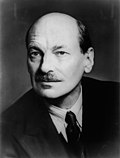
Something wrong?He built the British welfare state from the rubble of World War II - nationalised industries, launched the NHS, housed a shattered nation - then lost power and faded into a reputation for being boring. History remembers the institutions, not the man.
A life in dates
Also in Deutsch
Photos 8
 Person attlee2
 (De gauche à droite) Harry Gosling, John Scurr, major Atlee (i.e. Clement Attlee) - btv1b531387035
 1945 UK Opinion Polls
 Bevin Attlee H 42138
 1950 UK election polling
 1955 UK election polling
 Aankomst oudpremier Clement Attlee op Schiphol Clement Attlee tijdens de perscon, Bestanddeelnr 910-3564
 Aankomst oudpremier Clement Attlee op Schiphol, Bestanddeelnr 910-3559
In their own words 10
 ,
Socialism is not the invention of an individual. It is essentially the outcome of economic and social conditions.
Socialists do not propose to substitute the domination of society by one privileged class for that of another. They seek to abolish class distinctions altogether.
When we are returned to power we want to put in the statute book an act which will make our people citizens of the world before they are citizens of this country.
Awards
Family
Parents
Clement AttleePartners

Children
Brothers and sisters
Is this everyone?
Only relatives with a profile here are drawn, so a family can be larger than this. A line here can also be wrong.
Correct this familyAbout this person
Clement Richard Attlee was born on 3 January 1883 into an upper middle class family, son of a wealthy London solicitor, and trained as a barrister after Oxford. Volunteer work in London's East End shifted his politics leftward; he joined the Independent Labour Party, abandoned law, and began lecturing at the London School of Economics. Elected to Parliament in 1922 for Limehouse, he served in Ramsay MacDonald's governments and became Labour leader in 1935 after the party's landslide defeat. He took Labour into Churchill's wartime coalition in 1940, serving as deputy prime minister from 1942, then led the party to a landslide victory in 1945 on a platform of post-war recovery. His government inherited a country near bankruptcy, beset by shortages, and responded by nationalising utilities and major industries, passing the National Insurance and National Assistance Acts, creating the NHS in 1948, and building council housing at scale. Abroad, he oversaw the partition of India in 1947, decolonisation across Asia, the Marshall Plan, and the formation of NATO in 1949; he sent British troops to Korea. Labour narrowly won in 1950 but lost in 1951 despite winning the mos
Politicians from the United Kingdom 6




Fame.am measures public visibility signals. It does not measure human value, talent, morality, or credibility.