B. R. Ambedkar
Indian polymath, philosopher, and social reformer (1891-1956) · India · Academics · Died at 65
B. R. Ambedkar is read about 2,831 times a day, in 133 languages.
A typical day, 30 days to 15 October 2026
The middle day of the days counted, so one week of news cannot move it. The line under it is the last 390 days, one point a day.
Something wrong?He chaired the committee that drafted the Constitution of India - the architecture of the world's largest democracy - and spent his life dismantling caste from both the inside and the outside, finally leaving Hinduism altogether in 1956 and taking hundreds of thousands of Dalits with him into Buddhism.
A life in dates
Also in Deutsch
Photos 8


In their own words 10
 ,
I prefer Buddhism because it gives three principles in combination, which no other religion does.
Nothing is infallible. Nothing is binding forever. Everything is subject to inquiry and examination.
It is an incontrovertible fact that Christianity was not enough to end the slavery of the Negroes in the United States.
Awards
Family
Parents

 B. R. Ambedkar
Partners


Is this everyone?
Only relatives with a profile here are drawn, so a family can be larger than this. A line here can also be wrong.
Correct this familyAbout this person
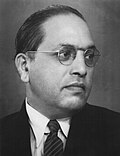
Bhimrao Ramji Ambedkar was born 14 April 1891 and built an improbable academic path out: Elphinstone College, then doctorates from Columbia University in 1927 and the London School of Economics in 1923, training in law at Gray's Inn - among the first Indian students to do so at either American or British institution in that decade. At Columbia he studied under John Dewey, absorbing pragmatist philosophy that would shape his later work. He returned as economist, professor, and lawyer, but his career turned political: campaigning for Dalit rights, negotiating through partition, publishing journals, advocating social freedom for those locked outside the caste system. When independence came, Jawaharlal Nehru named him Law and Justice minister, and Ambedkar chaired the committee that drafted India's Constitution, working from the debates of the Constituent Assembly and Sir Benegal Narsing Rau's first draft. In 1956, months before his death on 6 December, he renounced Hinduism and converted to Buddhism, initiating mass conversions and founding the Dalit Buddhist movement. In 1990 India gave him the Bharat Ratna; his followers still greet each other with "Jai Bhim."



Fame.am measures public visibility signals. It does not measure human value, talent, morality, or credibility.