Arthur Eddington
British astrophysicist (1882-1944) · United Kingdom · Scientists · Died at 61
Arthur Eddington is read about 315 times a day, in 61 languages.
A typical day, 30 days to 15 October 2026
The middle day of the days counted, so one week of news cannot move it. The line under it is the last 390 days, one point a day.
Something wrong?He told the world how stars burn - fusion of hydrogen into helium - before anyone had proof, and then sailed to an island off Africa to photograph starlight bending around the sun, handing Einstein his first empirical win.
A life in dates
Also in Deutsch
Photos 8
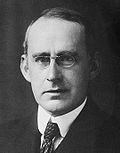
 Arthur Stanley Eddington
 1919 eclipse negative
 1919 eclipse positive
 PhysicistsinLeiden
 Arthur Stanley Eddington Bonn 1913
 Arthur Stanley Eddington by Samuel Johnson Woolf, 1934, charcoal and chalk on paper, from the National Portrait Gallery as a gift of Time magazine - NPG-NPG 78 TC344Eddington-000001
 De huldiging van Professor Lorentz bij de Hollandse Maatschappij der Wetenschappen in 1925
 Eclipse instruments at Sobral
In their own words 10
 ,
I am continually trying to find out why people find the procedure obscure.
There once was a brainy baboon, Who always breathed down a bassoon, For he said, "It appears That in billions of years I shall certainly hit on a tune".
It is impossible to trap modern physics into predicting anything with perfect determinism because it deals with probabilities from the outset.
Awards
Family
Parents
Arthur EddingtonIs this everyone?
Only relatives with a profile here are drawn, so a family can be larger than this. A line here can also be wrong.
Correct this familyAbout this person
Arthur Stanley Eddington was born on 28 December 1882 in England and trained as both astrophysicist and mathematician. Around 1920, when the source of stellar energy was a complete mystery, he published "The Internal Constitution of the Stars" and correctly speculated that stars fuse hydrogen into helium - foreshadowing the discovery of nuclear fusion by years. After World War I fractured scientific exchange between England and Germany, he wrote articles that introduced Einstein's general relativity to English speakers, then led an expedition to the Island of Príncipe on 29 May 1919 to observe a solar eclipse, producing one of the earliest confirmations of the theory. He became a celebrated populariser of Einstein's work and later a philosopher of science, speculating on quantum mechanics' implications for mind and matter. The Eddington limit - the natural ceiling on stellar luminosity and radiation from accretion - bears his name. He died on 22 November 1944.


Fame.am measures public visibility signals. It does not measure human value, talent, morality, or credibility.