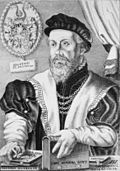
Andreas Vesalius
Flemish anatomist, physician and author (1514-1564) · Doctors · Died at 49
He opened bodies when doing so meant fighting fifteen centuries of received wisdom - and what he found inside didn't match the textbooks everyone had been copying since Galen.
Andreas Vesalius is read about 657 times a day, in 75 languages.
A typical day, 30 days to 30 October 2026
The middle day of the days counted, so one week of news cannot move it. The line under it is the last 400 days, one point a day.
Something wrong?People around Andreas


 Andreas Vesalius
Partners
Is this everyone?
Only relatives with a profile here are drawn, so a family can be larger than this. A line here can also be wrong. A marriage is drawn as ended only where its end is recorded, so a spouse drawn here may be a former one.
Correct this familyAlso in Deutsch
Media & music
Photos 8
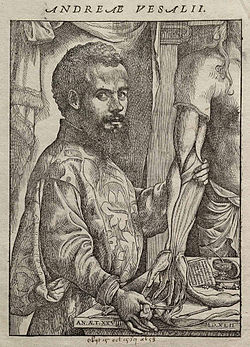
 Vesalius Fabrica portrait
 A. Vesalius "Epistola rationem...", 1546 Wellcome L0017085
 A. Vesalius "Epistola rationem...", 1546, last leaf Wellcome L0017087
 A. Vesalius, Anatomicarum G. Fallopii observ Wellcome L0032124
 A. Vesalius, bones of hand, with text above Wellcome L0029563
 A. Vesalius, De humani corporis fabrica libri septem Wellcome L0031003
 A. Vesalius, De humani corporis fabrica libri septem Wellcome L0031004
 A. Vesalius, De humani corporis fabrica libri septum Wellcome L0031072
In their own words 3
, I strive that in public dissection the students do as much as possible.
In our age nothing has been so degraded and then wholly restored as anatomy.
I am not accustomed to saying anything with certainty after only one or two observations.
About this person
Born in Brussels in 1514, Andries van Wezel took the Latinized name Andreas Vesalius and became a professor at the University of Padua in 1537. Between then and 1542, he dissected cadavers with his own hands - a practice most physicians considered beneath them - and documented what he actually saw. The result was De Humani Corporis Fabrica Libri Septem, published in seven books, which dismantled Galen's long-dominant anatomical errors and redrew the map of the human body. The work made him founder of modern human anatomy and earned him a position as Imperial physician at the court of Emperor Charles V. He died in 1564, sixteen years after the book that made looking inside us a science instead of an inheritance.