Alexis Carrel is read about 281 times a day, in 67 languages.
A typical day, 30 days to 15 October 2026
The middle day of the days counted, so one week of news cannot move it. The line under it is the last 390 days, one point a day.
Something wrong?He won the Nobel Prize for joining blood vessels that surgeons had never successfully sewn before. Then he built a mechanical heart with the world's most famous pilot, championed growing human tissue in glass, and ended his career designing eugenic policy for a collaborationist regime.
A life in dates
Also in Deutsch
Photos 8


In their own words 8
 ,
The democratic creed does not take account of the constitution of our body and of our consciousness. It does not apply to the concrete fact which the individual is.
Men cannot follow modern civilization along its present course, because they are degenerating. They have been fascinated by the beauty of the sciences of inert matter.
We must single out the children who are endowed with high potentialities, and develop them as completely as possible.
Awards
Family
Alexis CarrelPartners
Is this everyone?
Only relatives with a profile here are drawn, so a family can be larger than this. A line here can also be wrong.
Correct this familyAbout this person
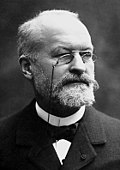
Alexis Carrel was born in France on 28 June 1873 and crossed the Atlantic to do most of his work in American laboratories. In 1912 he took the Nobel Prize in Physiology or Medicine for developing vascular suturing techniques that let surgeons reconnect severed vessels - the foundation of modern vascular surgery. With Charles Lindbergh he invented the first perfusion pump, a device meant to keep organs alive outside the body, though by the 1940s the design proved impractical and faded from use. He pushed forward work in tissue culture, transplantology, and thoracic surgery through the interwar decades. During the Vichy period he returned to France and took a leading role in implementing eugenic policies under the collaborationist government. He died on 5 November 1944.



Fame.am measures public visibility signals. It does not measure human value, talent, morality, or credibility.