Al-Zahrawi
Arab Andalusian physician, surgeon and chemist (936-1013) · Spain · Doctors · Lived 936 to 1010 · aged 74
Al-Zahrawi is read about 319 times a day, in 52 languages.
A typical day, 30 days to 15 October 2026
The middle day of the days counted, so one week of news cannot move it. The line under it is the last 390 days, one point a day.
Something wrong?His surgical textbook ruled European medicine for five centuries, and some of the instruments he designed in tenth-century Córdoba are still in operating rooms today.
Also in Deutsch
Photos 12
 Two pages from the Arabic manuscript of the Kitab al-Tasrif. Middle East, 13th century, Chester Beatty Library.
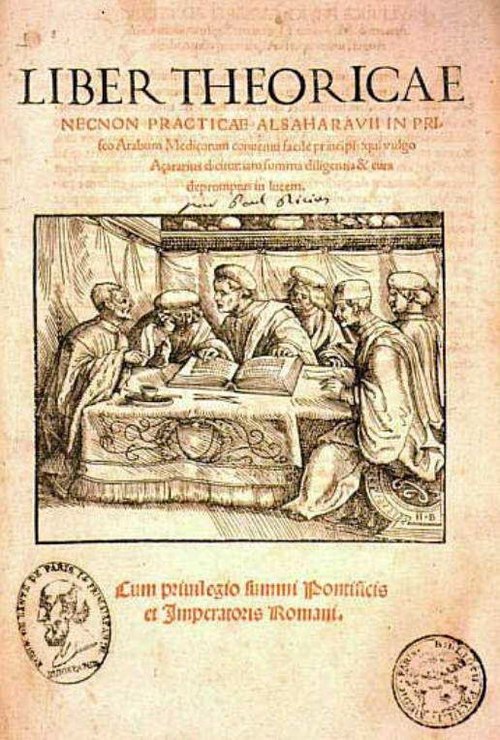 Frontispiece of the Latin translation of al-Zahrawi's Kitab al-Tasrif
 Page from a 1531 Latin translation by Peter Argellata of Al-Zahrawi's treatise on surgical and medical instruments
 Surgical instruments described by al-Zahrawi
 Albucasis blistering a patient in the hospital at Cordova
 Calle Albucasis street at Cordova

About this person
Abū al-Qāsim al-Zahrāwī practiced medicine in al-Andalus during the late tenth and early eleventh centuries, working in an era when the Islamic world led in medical knowledge. His thirty-volume encyclopedia, the Kitab al-Tasrif, synthesized surgical techniques with an emphasis on practical procedure. The surgery volume, translated into Latin, became the standard teaching text across Europe for the next five hundred years. He pioneered catgut for internal stitching, identified hemophilia as hereditary, described abdominal pregnancy, and traced certain paralyses to spinal injury. He also designed instruments for cataract removal and Caesarean section. Al-Zahrāwī died in 1013, but his tools and methods carried forward - some still in clinical use a millennium later.


Fame.am measures public visibility signals. It does not measure human value, talent, morality, or credibility.