
What kind of moment: History, Election
1948 United States presidential election: Harry S. Truman wins
- When
- 2 November 1948
- Where
- United States
- Truman's popular vote margin
- 49.6% to Dewey's 45.1%
Harry S. Truman won reelection as U.S. President on November 2, 1948, defying widespread predictions of a Republican victory. Truman's upset win over New York Governor Thomas E. Dewey preserved Democratic control of the White House and validated his aggressive campaign strategy of attacking the Republican-controlled Congress.
Truman's victory gave him a full term in his own right and validated his more assertive approach to Cold War foreign policy and domestic liberalism. The election also revealed deep fractures in the Republican Party and the collapse of the segregationist Dixiecrat challenge, reshaping American politics for the next two decades.
In numbers
- Truman's popular vote margin
- 49.6% to Dewey's 45.1%
- Voter turnout
- 57.3% of eligible voters
The result
Seats, change and vote share as the results table of 1948 United States presidential election gives them. No readers here: daily readers are counted from 2015 on.
How it unfolded
Election year begins with Truman's popularity at historic low
President Harry S. Truman entered 1948 with approval ratings around 35%, facing a fractured Democratic Party and predictions of certain defeat by major political figures and pollsters.
Democratic National Convention date set
Southern Democrats bolt to form States' Rights party
Southern delegates walking out of the Democratic National Convention after the party adopted a civil rights plank, nominating South Carolina Governor Strom Thurmond as the Dixiecrat candidate.
Dewey begins frontrunner's campaign
Republican nominee Thomas E. Dewey, Governor of New York, launched his general election campaign as the prohibitive favorite according to every major poll and political analyst.
Election Day: Truman defeats Dewey in historic upset
Against all predictions, Truman won 303 electoral votes to Dewey's 189, with 49.6% of the popular vote. Thurmond captured 39 electoral votes from the Deep South; Wallace won no electoral votes.
Chicago Tribune prints premature headline
- What followed
1949: Polling industry undergoes fundamental reformation
- What followed
1950: Civil rights movement gains federal legitimacy
- What followed
1952: Republican Party recalibrates conservative strategy
Where it sits in their lives
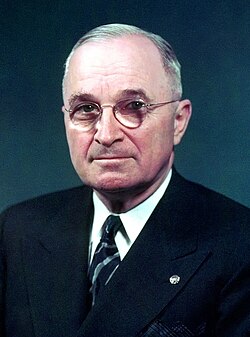 Harry S. Truman1884 to 197264
 Strom Thurmond1902 to 200345
 Henry A. Wallace1888 to 196560
 Thomas E. Dewey1902 to 197146
- Their age at this moment
- Their other moments in history
Who stood


More about this election
Also named in the story
Before and after, with the same people
- Potsdam Conference
 TrumanSee the moment ›
- Atomic bombing of HiroshimaTrumanSee the moment ›
- 1948 United States presidential election: Harry S. Truman wins
 Truman, Thurmond, WallaceThis moment
- Korean War beginsTrumanSee the moment ›
- 1952 United States presidential election: Dwight D. Eisenhower wins
 Truman, DobbsSee the moment ›