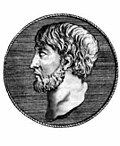
Xenophanes
Greek Pre-Socratic philosopher (c.570-c.478 BC) · Turkey · Academics · Lived 570 BC to 478 BC · aged 92
Xenophanes is read about 363 times a day, in 73 languages.
A typical day, 30 days to 15 October 2026
The middle day of the days counted, so one week of news cannot move it. The line under it is the last 390 days, one point a day.
Something wrong?He mocked Homer for making gods petty and vain, then built one of the first fully naturalistic pictures of the cosmos - no divine whim required, just clouds and first principles.
Also in Deutsch
Photos 2


In their own words 2
 ,
There is one god, greatest among gods and men, similar to mortals neither in shape nor in thought.
For all things are from the earth and to the earth all things come in the end.
About this person
Born in Ionia around 570 BC, Xenophanes spent his life wandering the Greek-speaking world, writing elegiac couplets that took aim at his culture's obsessions: athletic glory, excess, wealth. He reserved his sharpest lines for the poets, especially Homer, whose gods behaved like fools and cowards. What survives of his work comes only in fragments quoted by later writers. But those fragments mark a turn: Xenophanes explained rainbows and clouds without invoking myth, grounding physical events in observable principles instead. He also drew distinctions between knowledge and belief, an early sketch of epistemology. The Eleatics and Pyrrhonists later claimed him as their founder, reading their own systems back into his lines - a move modern scholars mostly reject.




Fame.am measures public visibility signals. It does not measure human value, talent, morality, or credibility.