Wolfgang Pauli
Physicist, Nobel prize winner (1900-1958) · United States · Scientists · Died at 58
Wolfgang Pauli is read about 766 times a day, in 93 languages.
A typical day, 30 days to 15 October 2026
The middle day of the days counted, so one week of news cannot move it. The line under it is the last 390 days, one point a day.
Something wrong?A theoretical physicist who told the universe it couldn't put two electrons in the same quantum state - and turned out to be right. The exclusion principle bearing his name underpins why matter has structure at all, why atoms don't collapse, why you're solid instead of a smear of particles.
A life in dates
Also in Deutsch
Photos 5
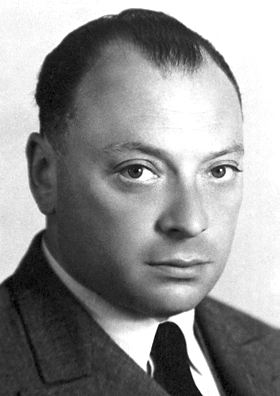

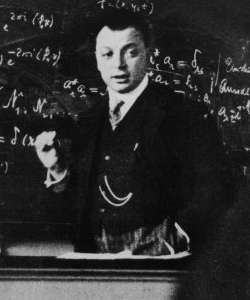

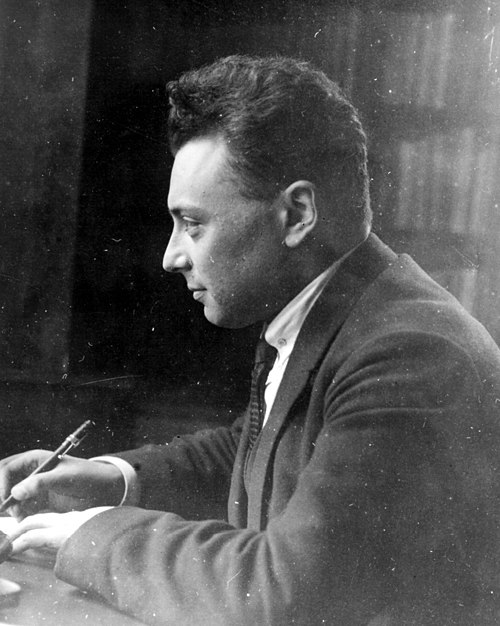
In their own words 10
This is to show the world that I can paint like Titian. [A big drawing of a rectangle] Only technical details are missing.
The best that most of us can hope to achieve in physics is simply to misunderstand at a deeper level.
The designation "Jungian Psychology" is actually already unscientific sectarianism. I only acknowledge C. G. Jung's contribution to the general psychology of the unconscious.
Awards
Family
Parents
Partners
Is this everyone?
Only relatives with a profile here are drawn, so a family can be larger than this. A line here can also be wrong.
Correct this familyAbout this person
Wolfgang Ernst Pauli was born 25 April 1900, an Austrian who would become Swiss and help invent quantum mechanics from the inside. In 1945, nominated by Einstein, he won the Nobel Prize in Physics for discovering the exclusion principle - the rule, grounded in spin theory, that explains the architecture of matter itself. Five years after that triumph, he'd already made another leap: in 1930, troubled by energy going missing in beta decay, he proposed a tiny neutral particle to balance the books. Fermi named it the neutrino. It took until 1956, two years before Pauli's death on 15 December 1958, for anyone to actually catch one.


Fame.am measures public visibility signals. It does not measure human value, talent, morality, or credibility.