William Gilbert
English physician, physicist and natural philosopher (1544-1603) · United Kingdom · Doctors · Died at 59
William Gilbert is read about 159 times a day, in 65 languages.
A typical day, 30 days to 15 October 2026
The middle day of the days counted, so one week of news cannot move it. The line under it is the last 390 days, one point a day.
Something wrong?William Gilbert wrote the book that turned magnetism from parlor trick into science. De Magnete, published in 1600, was the first serious experimental study of magnetic force - and it made him the father of a field that wouldn't have a name for another two centuries.
Also in Deutsch
Photos 8
 William Gilbert
 Demundo
 Gilbert demonstrating the magnet before Queen Elizabeth Wellcome M0000132
 Gilberts versorium needle electroscope
 Kopernikus, Gilbert, Galilee, Kepler
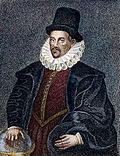
 Portrait of William Gilbert (1540-1603) Wellcome L0001749
 Monument to Dr. William Gilbert, in Holy Trinity Church Wellcome M0008989
 Portrait of Doctor William Gilbert Wellcome M0002634
In their own words 3
 ,
Only on the superficies of the globes is plainly seen the host of souls and of animate existences, and their great and delightful diversity the Creator taketh pleasure
How far away from the earth are those remotest of stars: they are beyond the reach of eye, or man's devices, or man's thought. What an absurdity is this motion (of spheres).
William Gilbert of Colchester, Physician of London: On the Load Stone and Magnetic Bodies by William Gilbert, Edward Wright; J. Wiley & Sons (1893) public domain @GoogleBooks.
Family
Parents
William GilbertIs this everyone?
Only relatives with a profile here are drawn, so a family can be larger than this. A line here can also be wrong.
Correct this familyAbout this person
Gilbert was an English physician and natural philosopher born around May 24, 1544, who built his reputation by rejecting the Aristotelian orthodoxy that still ruled universities. He favored experiment over scholastic argument, a stance that led him to magnetism. In 1600 he published De Magnete, the work that secured his legacy and established magnetic study as a discipline rooted in observation rather than speculation. A unit of magnetomotive force - magnetic potential - was later named the Gilbert in his honor, though it has since been replaced by the ampere-turn. He died on November 30, 1603.
Doctors from the United Kingdom 6




Fame.am measures public visibility signals. It does not measure human value, talent, morality, or credibility.