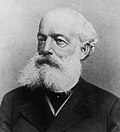
Walther Nernst
German physical chemist and physicist (1864-1941) · Germany · Scientists · Died at 77
Walther Nernst is read about 160 times a day, in 75 languages.
A typical day, 30 days to 20 October 2026
The middle day of the days counted, so one week of news cannot move it. The line under it is the last 395 days, one point a day.
Something wrong?He pinned down the behavior of matter at absolute zero - work so fundamental it earned him a Nobel and became the third law of thermodynamics.
A life in dates
Also in Deutsch
Photos 8


Awards
In their orbit
About this person
Nernst studied physics and mathematics across Zürich, Berlin, Graz, and Würzburg, earning his doctorate in 1887. That same year he developed the Nernst equation, a tool for predicting the voltage of electrochemical cells. He completed his habilitation at the University of Leipzig in 1889. His major contribution came with the Nernst heat theorem, which described how entropy behaves as temperature approaches absolute zero - foundational work that opened the door to the third law of thermodynamics. The theorem won him the 1920 Nobel Prize in Chemistry. His reach stretched across thermodynamics, electrochemistry, physical chemistry, and solid-state physics, mapping the edges where energy and matter meet.



Fame.am measures public visibility signals. It does not measure human value, talent, morality, or credibility.