Walter Benjamin
German cultural critic, philosopher and social critic (1892-1940) · Academics · Died at 48
Walter Benjamin is read about 1,963 times a day, in 71 languages.
A typical day, 30 days to 20 October 2026
The middle day of the days counted, so one week of news cannot move it. The line under it is the last 395 days, one point a day.
Something wrong?A German-Jewish philosopher who wrote about art, history, and reproducibility - then fled the Nazis in 1940 and died by suicide at the Spanish border, hours from escape. His essays went unread in his lifetime, then became canonical decades later when Hannah Arendt brought them to English readers in 1968.
A life in dates
Also in Deutsch
Photos 8
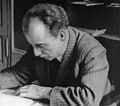
 Walter Benjamin vers 1928
 Benjamin-Zitat 052016
 Demian Berger, Ästhetische Moderne im Widerspruch 2019
 Dora Benjamin Kellner mit Sohn Stefan um 1920
%2C_designed_by_Sasha_Stone.jpg?width=1200) Full cover of Walter Benjamin's "Einbahnstraße" (1928), designed by Sasha Stone
Full cover of Walter Benjamin's "Einbahnstraße" (1928), designed by Sasha Stone Konstellation Benjamin
 Leon Kellner death notice, Vienna, 1928
 Public Domain Day poster 2011
In their own words 10
 ,
, Mechanical reproduction emancipates the work of art from its parasitical dependence on ritual.
Reminiscences, even extensive ones, do not always amount to an autobiography.
Ich packe meine Bibliothek aus ("Unpacking my library", 1931), p. 2
Family
Walter BenjaminPartners

Brothers and sisters

Is this everyone?
Only relatives with a profile here are drawn, so a family can be larger than this. A line here can also be wrong.
Correct this familyAbout this person
Born in Berlin in 1892, Walter Bendix Schönflies Benjamin wove German idealism, Jewish mysticism, and Marxism into a body of criticism that defied easy classification - even his closest colleagues couldn't agree whether he was a philosopher at all. He wrote major essays on Kafka, Baudelaire, Proust, and translated chunks of both, orbiting the Frankfurt School while maintaining a lifelong correspondence with Gershom Scholem that helped resurrect interest in the Kabbalah. His best-known works - "The Work of Art in the Age of Mechanical Reproduction" and "Theses on the Philosophy of History" - came in 1935 and 1940, but popular recognition never arrived. In September 1940, trying to cross from France into Spain at Portbou, he took his own life rather than be captured by the Third Reich. His companions were allowed through, shaken by his death. Fifteen years later Suhrkamp began publishing his complete works in German; in 1968 Arendt introduced him to the Anglosphere, and posthumous renown finally came.
Academics born in the 1890s 6




Fame.am measures public visibility signals. It does not measure human value, talent, morality, or credibility.