Umberto Eco
Italian semiotician, essayist, philosopher, literary critic, and novelist (1932-2016) · Italy · Writers · Died at 84 · also Serbia
Umberto Eco is read about 2,620 times a day, in 115 languages.
A typical day, 30 days to 15 October 2026
The middle day of the days counted, so one week of news cannot move it. The line under it is the last 390 days, one point a day.
Something wrong?The Italian semiotician who turned medieval monastery murders into a surprise bestseller, proving that a thriller stuffed with Latin, heresy, and footnotes could sell millions - then spent the rest of his life writing everything from children's books to a prescient anatomy of fascism.
A life in dates
Also in Deutsch
Photos 8
 Italiaanse schrijver Umberto Eco , kop, Bestanddeelnr 932-9758
 2011-03-04 Margot Dijkgraaf en Umbert Eco in De Rode Hoed
 2011-03-04 Umberto Eco en Margot Dijkgraaf in De Rode Hoed
.jpg?width=1200) 2011-03-04 Umberto Eco signeert (De Rode Hoed)
2011-03-04 Umberto Eco signeert (De Rode Hoed) Frankfurter Buchmesse 2011 - Scheck und Eco
 Frankfurter Buchmesse 2011 - Umberto Eco
_en_minister_Brinkman%2C_Bestanddeelnr_934-1145.jpg?width=1200) Boekenconferentie in Amsterdam Umberto Eco (links) en minister Brinkman, Bestanddeelnr 934-1145
Boekenconferentie in Amsterdam Umberto Eco (links) en minister Brinkman, Bestanddeelnr 934-1145_en_minister_Brinkman%2C_Bestanddeelnr_934-1146.jpg?width=1200) Boekenconferentie in Amsterdam Umberto Eco (links) en minister Brinkman, Bestanddeelnr 934-1146
Boekenconferentie in Amsterdam Umberto Eco (links) en minister Brinkman, Bestanddeelnr 934-1146In their own words 10
 ,
, I don't even have an E-mail address. I have reached an age where my main purpose is not to receive messages.
To read fiction means to play a game by which we give sense to the immensity of things that happened, are happening, or will happen in the actual world.
How should we deal with intrusions of fiction into life, now that we have seen the historical impact that this phenomenon can have?
Awards
In their orbit
About this person
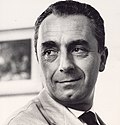
Umberto Eco was born 5 January 1932 and built his career as a medievalist and philosopher at the University of Bologna, where he would teach for decades. In 1980 he published The Name of the Rose, a historical mystery that wove semiotics, biblical analysis, and literary theory into popular fiction; it became an unexpected international phenomenon. Foucault's Pendulum followed in 1988, touching on similar dense territory. Beyond novels he wrote prolifically: children's books, translations, and from 1985 onward a twice-monthly column "La Bustina di Minerva" for L'Espresso - his last piece, on Romantic painter Francesco Hayez, appeared 27 January 2016, weeks before his death on 19 February. His 1995 essay "Ur-Fascism", listing fourteen properties of fascist ideology, has gained new attention in the 21st century.




Fame.am measures public visibility signals. It does not measure human value, talent, morality, or credibility.