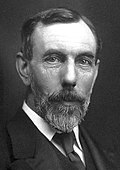
Thomas Henry Huxley
British biologist and comparative anatomist (1825-1895) · United Kingdom · Scientists · Died at 70
Thomas Henry Huxley is read about 537 times a day, in 75 languages.
A typical day, 30 days to 15 October 2026
The middle day of the days counted, so one week of news cannot move it. The line under it is the last 390 days, one point a day.
Something wrong?He earned the nickname "Darwin's Bulldog" not for discovering evolution but for fighting its battles in public - most famously in an 1860 Oxford debate where he faced down a bishop coached specifically to defeat him.
A life in dates
Also in Deutsch
Photos 8
.jpg?width=1200) T.H.Huxley(Woodburytype)
T.H.Huxley(Woodburytype).png?width=1200) 16th century cannibalism (cropped)
16th century cannibalism (cropped) 16th century cannibalism
 Some Fellows of the Royal Society Wellcome V0006745
 1911 Britannica-Anthropology-2
 4MarlboroughPlace
_(19962992373).jpg?width=1200) A catalogue of portraits, paintings and sculpture at the Natural History Museum, London (1995) (19962992373)
A catalogue of portraits, paintings and sculpture at the Natural History Museum, London (1995) (19962992373) BC AULB 130PP CS 85.5
In their own words 10
 ,
, M. Comte's philosophy, in practice, might be compendiously described as Catholicism minus Christianity.
The improver of natural knowledge absolutely refuses to acknowledge authority, as such. For him, scepticism is the highest of duties; blind faith the one unpardonable sin.
Let us have "sweet girl graduates" by all means.
Awards
Family
Parents
Thomas Henry HuxleyPartners

Children


Brothers and sisters
Is this everyone?
Only relatives with a profile here are drawn, so a family can be larger than this. A line here can also be wrong.
Correct this familyAbout this person
Thomas Henry Huxley had almost no formal schooling and taught himself comparative anatomy well enough to become, by some accounts, the finest practitioner of the later 19th century. He worked through invertebrates first, then vertebrates, and after studying Archaeopteryx alongside Compsognathus concluded correctly that birds descended from small carnivorous dinosaurs. In 1860 he nearly skipped the Oxford debate on evolution but stayed after a chance encounter, then spent the next decades as Darwin's most vocal defender - even while privately doubting gradualism and remaining uncertain about natural selection itself. He pushed scientific education forward in Britain, coined the term "agnosticism" in 1869 to describe what can and cannot be known, and delivered an 1893 lecture on evolution and ethics that, translated into Chinese, reshaped how Darwin's ideas entered that country.
Scientists from the United Kingdom 6




Fame.am measures public visibility signals. It does not measure human value, talent, morality, or credibility.